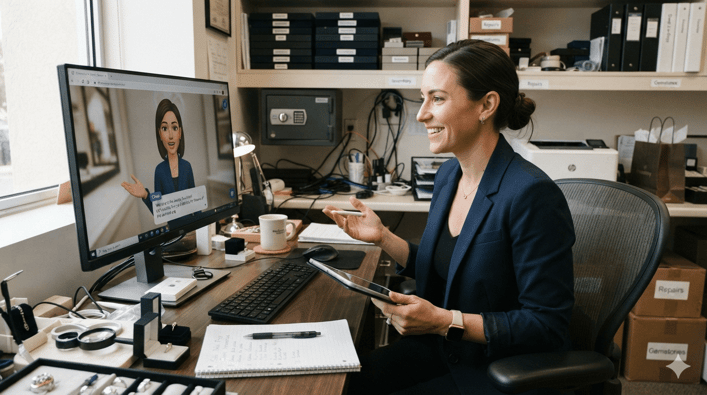


AI retail sales training uses AI role-play to let an associate practice real selling conversations before they ever face a customer. Instead of learning on your live traffic or shadowing whichever veteran is free, a new hire runs the greeting, the rapport, the objection, and the close against an AI that talks back, as many times as it takes, until they cannot get it wrong. It does not replace the salesperson or the manager. It gives the human the reps to be better on the floor.
Here is what it is, whether it works, and how to judge it.
What is AI retail sales training?
It is practice, scored and repeatable, for the behaviors that move a sale. Product training teaches an associate what a sofa is made of. AI sales training teaches them what to do in the ninety seconds after someone walks in: open without "what are you looking for," build rapport, present in terms of how the customer will live with the product, handle "I want to think about it," and ask for the sale. The AI plays the customer so the associate can fail in private and arrive on the floor already fluent.
The reason this matters: most floors train by throwing a new person next to a busy veteran and hoping habits rub off. That is a lottery. AI role-play makes the practice consistent, so every associate learns to sell the same way whether they are in store one or store forty.
Does AI sales training actually work for retail?
Yes, when it trains behavior and measures it, not when it hands out tips. The test is whether the close rate moves and whether you can prove it. Real SalesRX and SalesRX+ clients show the pattern. Cabinets To Go trained across 106 stores and 99% of associates reported improvement. Circle Furniture's owner Richard Tubman went from being happy with 5 to 8% months to running months of 18, 20, and 25%. Big Island Living, two first-time owners in Hawaii, grew from about $655,000 to $1.5 million, then $2 million, and are closing on $2.5 million using the framework. Across the platform, 83% of users report a double-digit sales increase within six months.
The measurement is the part most programs skip. A SalesRX+ engagement includes a mystery shop of your team, over 900 points, before anyone trains and again at six months, so the gain arrives in writing, not as an opinion.
How does AI role-play train a retail associate?
It gives them at-bats. A salesperson learns selling the way a chess player learns chess or an improv actor learns to perform: not by memorizing lines, but by drilling the principles until they can respond to a board or a scene nobody has seen before. AI role-play is the drill. The associate practices the greeting, gets a customer who says "just looking," and learns that the words that earned the brush-off were their own. They run it again. By the time a real couple walks in, the pattern is muscle memory, and it sounds like the associate, not a script.
Clients do not wait to be told this. Joy Lee at USA Fishing Outfitters built her own version: "We created interstore Zoom mock training sessions so that everybody across stores could practice their skills."
Rebecca Wierda at Leigh's watched what it did to her floor: "When we did our role playing, our team was so engaged and so excited in the conversation that kept getting generated around that, and then learning from each other and bouncing ideas."
Both said that on camera, unprompted, about practice they organized themselves. The reps are the point. AI role-play is how you get them without putting everybody on a Zoom call at 8 a.m. If you want the human version too, here is how to role play for sales training without your crew hating it.
What is Sidekick Rex?
Sidekick Rex is the AI role-play coach inside SalesRX+. It plays the customer, your associate plays the associate, and the conversation goes wherever the associate takes it, including off script, because that is what customers do.
An associate can run the same scenario before opening, on a slow Tuesday, or the night before their first shift, as many times as they need. No manager has to stand there pretending to be a shopper, which is the part everybody dreads about role play.
You can see how a session is built without logging in. The Sidekick Rex mock session generator puts together a practice scenario for your store.
Can AI replace a retail salesperson or a sales trainer?
No, and any program that claims it can misunderstands the floor. A $3,000 to $15,000 purchase is a considered purchase. It needs a person to build trust, read the room, and ask for the sale, and the merchandise cannot do that job. AI does not stand on your floor. It trains the human who does. Same with the manager: AI gives the reps and the score, the manager coaches to it and holds the floor accountable. Remove the human and you are back to a website, which is the one thing a physical store is supposed to beat.
Is AI sales training better than traditional retail training?
It is better than the two most common versions, and it depends on the third. Product-only training teaches facts an associate cannot use until they can hold a conversation. Tip-based training ("when they say this, say that") collapses the moment a real customer goes off script. Behavior training delivered with AI role-play beats both, because it changes what the associate does and lets them practice it to fluency. Live in-person training also works and always will, but it is expensive to repeat for every new hire. AI role-play makes the practice repeatable at the cost of a seat, not a trainer's day.
What should you look for in an AI retail sales training program?
Look for behavior over facts, practice before the customer, measurement after, and a manager track so someone on the floor can coach it. If you are comparing options, start with the best retail sales training programs, and before you sign, read the questions to ask before you buy an AI sales training program.
Frequently asked questions
What is AI retail sales training?
AI retail sales training uses AI role-play so associates practice real selling conversations, the greeting, rapport, objections, and the close, before they face a live customer. It trains selling behavior, not product facts, and scores whether the behavior actually changed.
Does AI sales training work?
Yes, when it trains behavior and measures the result. SalesRX and SalesRX+ clients show it: Cabinets To Go saw 99% of associates improve across 106 stores, Circle Furniture ran months of 18 to 25%, and 83% of users report a double-digit sales increase within six months.
What is Sidekick Rex?
Sidekick Rex is the AI role-play coach inside SalesRX+. It plays the customer so an associate can practice the greeting, rapport, objections, and the close as many times as they want, without a manager having to play pretend shopper.
Will AI replace my salespeople?
No. A considered purchase needs a human to build trust and ask for the sale. AI trains that human to be better, it does not stand on your floor or close the sale for you.
How is AI sales training different from product training?
Product training teaches what the merchandise is. AI sales training teaches what the associate does with a customer. You need both, but product knowledge is worthless if the associate never gets past the customer's guard to use it.
Selling furniture or home furnishings? See furniture sales training for showroom associates, where role-play sits inside the full sequence of greeting, discovery, and close.