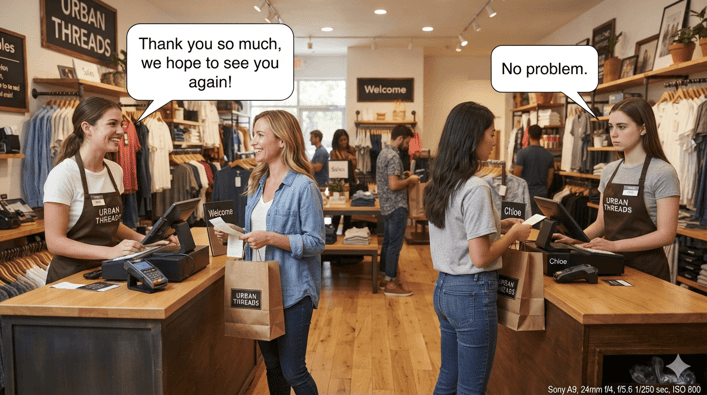


Retail sales training fails when the store's culture contradicts what it taught. Associates don't do what they learned in a course, they do what the person next to them does when the manager isn't looking.
Training is one phase of three: expectation set at hiring, commitment built in training, and accountability held on the floor. Buy the course and skip the other two and it dies by week two.
Picture you're interviewing for a job at Chick-fil-A. The manager looks at you and says, "We say my pleasure when customers thank us. Every single time. We take it seriously enough that we'll hold you accountable, and if you won't do it, we'll probably let you go. Are you okay with that?"
You want the job. You say yes.
Now picture the same interview at a store I train. "We greet every customer with good morning, good afternoon, or good evening. Every one. Not 'Can I help you?' Not a nod from behind the counter. Not, 'What's up?'" If you won't do it, this isn't the job for you. Are you okay with that?"
Same question. Same stakes. And whether that greeting survives past week two has almost nothing to do with the training program you bought.
Why doesn't retail sales training stick?
Sales training fails when the store's culture contradicts what the training taught. Associates don't do what they learned in a course.
They do what they see the person next to them doing when the manager isn't looking. That's where most fall flat: putting a newbie trained to your standards to work alongside someone who doesn't adhere to the training.
I ran a webinar recently where 9 out of 10 retailers admitted they had no formal sales framework at all. So when one of them finally buys training, they expect the training to carry the whole load. It can't.
Training is one phase of three, and most retailers skip the other two.
What are the three phases of building a standard?
Every standard in your store moves through three phases: expectation, commitment, and implementation. Miss any one and the standard dies.
Phase one: Expectation. This happens in the interview. Most retailers use the interview to vet a candidate. "Can you work the schedule?" Smart retailers use it to set expectations. Tell them exactly what you require on the floor and exactly what happens if they don't deliver. Then ask the question: Are you okay working in that environment? Make them say yes out loud before you make an offer.
Phase two: Commitment. This happens in training. Here's a secret about the training phase: people will commit to almost anything in it. Tell a new hire the greeting is good morning, good afternoon, or good evening, show them why it opens a sale, and nobody pushes back. They're new. They want to belong. They'll commit. That's what makes training the easiest phase and also the most misleading one, because commitment in a training room costs nothing.
Phase three: Implementation. This happens on the floor, alone. The first shift where nobody's watching is where the truth comes out. Your new hire delivers the greeting, then looks over at the ten-year veteran who mumbles "hey" or says nothing at all. In that moment, they learn what your store actually requires, and it isn't what the interview or the training said.
All those expectations? Theater. All that commitment? Optional.
What happens when a standard slips?
Every standard you let slip becomes your new standard. Let one associate skip the greeting and you haven't lost one greeting. You've announced to the entire floor that the greeting is negotiable.
Let them arrive 15 minutes late without a verbal warning, you've lost your schedule for everyone.
This is why Chick-fil-A can get teenagers to say "my pleasure" all day without irony. A new hire might privately think it sounds odd. Then they hit the floor and hear it from every direction, every transaction, every shift. The standard holds because everyone holds it. The words matter less than the wall of consistency around them.
Your store works the same way in reverse. If half your crew greets customers and half doesn't, you don't have a 50% standard. You have no standard. You're settling for pennies when you could have dollars.
What should retailers do before buying sales training?
Decide whether you're willing to change how you hire, how you train, and how you manage the floor. If the answer is no, save your money.
I say this as someone who sells sales training. When retailers put the full system behind it, the shops show it.
On our first unannounced mystery evaluation, stores average about 30%, and shoppers were ignored at 7 of 12. The stores that then work the system move up hard - one went from 46 to 95 on a later shop, and one hit 100.
That second number comes only from stores where the owner set the expectation at hiring, trained the why, and then held the standard every shift after.
Buying training and skipping the rest is like buying a gym membership and expecting the card in your wallet to do the workouts. You have to use it.
Here's the sequence that works:
- Rewrite your interview. Name your non-negotiables out loud, including the greeting, and get a verbal yes before you hire, arriving five minutes early in uniform or appropriate dress, etc.
- Train the why, not just the what. Associates commit harder when they understand a greeting delivered within seconds changes how the entire visit goes.
- Hold it on the floor. Walk your floor. When you hear the greeting, acknowledge it. When you don't, address it that day, not at the 90 day review.
- Apply it to everyone. Your veterans set the real standard. If they're exempt, your new hires will figure that out by Friday.
That sequence is what SalesRX online retail sales training is built around: the selling behaviors get trained, and an unannounced mystery shop measures whether they actually changed on the floor. For more on training that holds, see retail sales training.
The bottom line
Training doesn't fix culture. Training plus expectations plus accountability fixes culture, and culture is what your customers feel within five seconds of walking in.
So before you ask whether a sales training program works, ask a harder question: are you willing to hold the standard when it's inconvenient, when it's your best seller ignoring it, when nobody would notice if you let it slide?
Because your crew already knows the answer. They learned it the first shift nobody was looking.
Why does retail sales training fail?
Retail sales training fails when the store's culture contradicts it: associates copy the veteran next to them, not the course. It holds only when the owner sets the expectation at hiring, trains the why, and holds the standard on the floor every shift, for everyone.