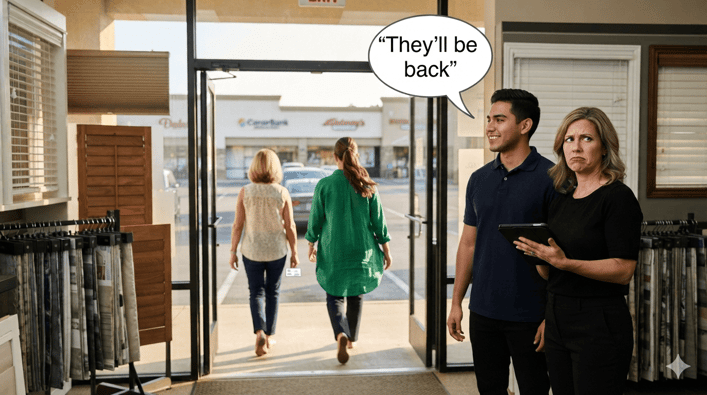


Because nothing got resolved and nothing got scheduled. "I need to think about it" is almost never about thinking. It is one of five objections the customer did not say out loud: the price, another decision-maker, wanting to look around, buying it online, or how it will look at home.
Usually it means trust was never built, which happened long before the close.
This is not a furniture problem, it is a considered-purchase problem
If you sell anything where the customer has to measure something, check with somebody, live with it for a decade, or wait for it to be delivered, you hear this every day. Furniture, flooring, window coverings, tile, mattresses, appliances, spas.
The ticket is high enough that walking out feels responsible. Your customer is not being difficult. They are being careful.
The mistake is not that they want to think. The mistake is that your associate has no idea what they are thinking about.
The question that surfaces the real objection
When you hear it, do not counter. Ask. "Is there anything else concerning you about purchasing today?"
"Anything else?" is the worst phrase you can use at the close and the best one you can use to surface a hidden objection. I have written about it before. The woman who would not buy the carpet was not stalling over money. She was dreading having to move the books off a bookcase, and nobody had asked.
What comes back is almost never "I need time." It is one of these five reasons for objections.
"It's more than I wanted to spend."
It is never about price. It is about them weighing your price against your words, and if they are weighing it against nothing, that is a selling problem and not a pricing one.
Price doesn't make something a good value. People do.
So do not defend the number and do not drop it. Reframe the decision around the problem they actually have. Somebody comes in for a garden hose and wants the cheap one. Ask a few questions and you find out they buy a cheap hose every three months, because summer heat builds pressure and bursts it.
Now you can show them the reinforced $39.95 hose that will not burst and is lighter and easier on their back, and the decision becomes about the problem instead of the price tag.
Two rules that go with it. Wait for the shopper to select one product before you justify any price. And if you do show them something cheaper, make sure they know exactly which of the features they told you mattered they are giving up to get there.
Never ask what their budget is. Classic selling mistake. It supposes they will not spend more than they planned, and ignores that fact that the best solutions cost more. Say this instead: "We have various options and price points. To find your best solution, would you be ok if I show you all of them?"
"I have to ask my husband." "I need to talk it over with my partner."
They are not telling you they lack the authority to buy. They are telling you they do not trust you yet.
That is why trying to reschedule for when the other person can come in almost never works. You are solving a problem they do not have.
Repeat back to them, kindly, what they told you they were looking for. Give them three benefits of your product. Then shut up. Done properly, that sequence closes the sale more often than any script you could run at them.
You can also turn the remark on its head: "What if that person says do it?" Or, "I'm sure you have plenty of expensive items in your closet. What did they tell you?"
One caution. Do not guess at who that person is. It might be a partner, a parent, an adult child, a roommate, or a business partner, and an associate who assumes wrong loses the room in about four seconds. Ask who else is in on the decision.
"We'll look around."
Turn the sale over to another associate.
That is not what you were taught and it is not what your commission structure wants to hear, but personalities do not always fit, and acknowledging that before the customer is out the door can boost conversion substantially. The customer is often looking for distance and does not want to hurt your feelings.
Summarize your conversation, get the shopper's name and introduce them to the other associate so they know where you are in your sales framework.
What you should not do is show them more products or ask more questions. That is the instinct, and it feels as pressure.
The deeper answer is that this objection is a late symptom of a step you skipped at the beginning. Engage the stranger, discover the shopper, make the customer, and the objection mostly disappears. That is the selling framework I teach.
"I can get it cheaper online."
Do not match the price. Price matching is a loser's limp. The moment you match, you have let a competitor set your pricing, and on a $1000 item you matched down to $500 you are now losing money on the cost to stock it and ship it.
You have three options. Keep selling and offer to help them walk out with it today. Address it head-on. Or thank them and let it go.
All three are better than discounting, and the third is a real option that most closing advice will not give you.
Remember where this conversation is happening. They are standing in your store. If they could have waited, they would have bought it online already.
And if you are hearing this all day, the problem is your sales process, not the shopper. When the merchandise is seen as nothing special and nobody built a relationship, it all just becomes price, and the phone in their pocket is always ready for a price check. And there is always someone cheaper...always.
"I want to see how it looks at home."
Pepper your presentation with information before it becomes an objection.
Peppering means naming the possible disappointments during your presentation rather than letting the customer discover them at the end: the timeline, the special order, the variation in color between the showroom and their living room. Do it early and you stay their friend instead of becoming their enemy at the register.
It sounds like this. "Colors read differently at home than they do under our lights, so take the sample with you and look at it in the room at night. If it's wrong, we'll fix it." Or, on delivery: "We can set the whole system up for you after you get it to your house. If you can't take the whole system with you today, we've got a company that can get the heavy pieces there. Make sense?"
A customer who feels safe buys. A customer who is quietly worried about one detail nobody mentioned goes home to think about it.
Then follow up, because the be-back rarely comes back on their own.
What it looks like on a furniture floor
Furniture salespeople can hear all five in one sale, which is why showrooms feel this hardest.
It is also the floor where the stall is most often self-inflicted. A shopper on their feet is still deciding whether to leave. Get them to sit down and the conversation changes, because now you have long enough to find out what the real objection is instead of walking them to the door.
The associates who cannot close are usually the ones who walked the floor alongside the customer the whole time and never got them seated. That is not selling. That is a tour, and a tour ends at the door.
The follow-up is the job, not the courtesy
Here is what actually happens on most floors. The customer leaves, the associate says, "Here's my card," and nobody ever calls because calling feels like begging.
They go to two more stores, and the one that followed up gets the sale, not the one with the better product.
So make the follow-up specific and scheduled before they walk out. Not "Give me a call." A day, a time, and a reason: "I'll text you tomorrow morning with the delivery window on the gray one."
And write down what they came in for - better yet take a picture and offer to text it to them. An associate who builds on that and texts, "Found the one with the deeper seat you wanted," is selling. An associate who texts "just checking in" is a nuisance.
How do you know if your floor is losing be-backs?
You send a stranger in.
You will not find this in your POS, because a customer who never returns leaves no record. The only way to see it is to watch what your associates actually do when somebody says they need to think about it.
On our mystery shops, first evaluations average 30%, and shoppers were ignored outright at 7 of 12 stores. Ignored. Not badly handled, not slow to close. Nobody spoke to them.
A floor that is not greeting people is not losing sales on the be-back. It is losing them an hour earlier, and no follow-up script fixes that.
Stores that worked the system moved 46 to 95, and one hit 100%. The average store that stopped using it scored 24% on the re-shop. Circle Furniture near Boston went from being happy with a 5 to 8% month to running months of 18, 20, and 25% and record sales every month.
The product did not change. The traffic did not change. What the associates said changed.
The bottom line
"I need to think about it" is the cheapest information you will get all day, and most floors throw it away.
Ask what is concerning them. Answer the objection they name. Set the follow-up before they are at the door with their keys out.
That is what SalesRX+ is built to do: train the selling behaviors, then measure with an unannounced shop whether they actually changed. For the full sequence, see retail sales strategies.
Frequently asked questions
Why do customers say they'll be back and never come back?
Because nothing was resolved and nothing was scheduled, and usually because trust was never built during discovery. Repeat back to them what they said was important to them. Ask what is concerning them before they leave, answer that objection, and set a follow-up with a day, a time, and a reason.
What do you say when a customer says they need to think about it?
"Is there anything else concerning you about purchasing today?" That surfaces the real objection, which could be about the price, another decision-maker, wanting to look around, buying it online, or a worry about how it will work at home.
How do you respond when a customer says it's more than they wanted to spend?
It is rarely about price. If it is their dream, they'll move heaven and earth to get it. Mention payment plans, and do not defend the number or discount it. Reframe the decision around the problem they actually have, and if you show them something cheaper, name exactly which feature they told you mattered that they are giving up.
What do you say when a customer has to ask their spouse?
They are signaling distrust, not a lack of authority. Repeat back what they told you they were looking for, give three benefits, and stop talking. Or ask what that person would say if they said "Do it."
How do you answer "I can get it cheaper online"?
Never match the price. Price matching is a loser's limp. Keep selling and offer to help them walk out with it today, address it head on, or thank them and let it go. And remember they are standing in your store, which means they could not wait.
How do you handle a be-back in a furniture store?
Get the customer seated - ideally on the piece they are gravitating towards - before you go anywhere near the close, because a shopper on their feet is still deciding whether to leave. Then work the five objections. Furniture stacks all of them into one sale.
How do you train associates to handle the be-back?
Rehearse it before it happens on your floor. Associates who have never said the words out loud will freeze and default to handing over a card. Practice the question and the five objections until the answers are automatic, then measure it with an unannounced mystery shop to hold them accountable - before they hold your monthly quota hostage.