

You raise a furniture store's closing rate by fixing what your associates do in the first ninety seconds and training them to sell the whole room, not by adding software or counting more traffic. Most furniture floors close a small share of the people they greet, and the number sits still because the selling never changes. Train the behavior, practice it, and measure it, and the same doors produce more sales.
What is a good closing rate for a furniture store?
Higher than you think, and almost always higher than what you are getting. Most floors close 8 or 9% of the people they greet. Owners swear it is more, and it is not, and you will not know until you count. Put a door counter in and tie it to your POS, and you have a real conversion rate instead of a guess. A door counter runs about a hundred dollars a month. The counter tells you the number; it does not move it.
Why is my furniture store's closing rate low?
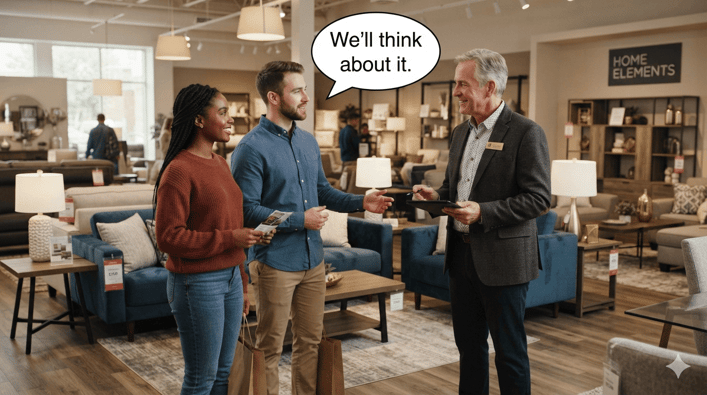
Because your associates are waiting to be interrupted instead of selling. The greeting is weak or skipped, the shopper is left to "just look," the associate sells the one piece the customer pointed at instead of the whole room, and when price comes up they discount instead of building value. None of that is a traffic problem or a product problem. It is a selling problem, and selling is trained.
How do you actually raise it?
Run one sequence every time and hold the line on it. Greet and let the customer settle. Build enough rapport to earn the right to sell. Ask what changed that brought them in. Show them the room that answer calls for, starting at the top, not the clearance tag. Ask for the sale. Then follow up, because the be-back never comes back on its own. Practice each move off the floor until it is automatic, and measure whether it is happening.
The proof this works is on real furniture floors. Circle Furniture near Boston went from being happy with a 5 to 8% month to running months of 18, 20, and 25%. Big Island Living in Hawaii grew from about $655,000 to a projected $2.5 million on the same doors. On our mystery shop, Interior Spaces in Ridgeland, Mississippi went from 46% on the first unannounced shop to 95% on a later one. Across our shops, first evaluations average 30% and shoppers were ignored outright at 7 of 12 stores.That is what training the selling does that a traffic counter never will.
How do you get a furniture customer to sit down?
Ask her to, early, and give her a reason that is about her and not about the sofa. On a furniture floor, seating is not a courtesy. It is the close.
A shopper on her feet is still deciding whether to leave. Once she is sitting on the sectional with her purse off her shoulder, the conversation changes and you have her long enough to actually sell her something.
A furniture retailer put it to me plainly: the associates who could not close were almost always the ones who walked the floor beside her the whole time and never got her off her feet.
Walking alongside a customer feels like service. It is a tour. And a tour ends at the
door.
So make the invitation specific. “Sit here a second, this is the one people tell me they can’t get up from.” If she came in for a family room, put her in the corner seat she would actually use at home. Then sit down yourself, at an angle, not across from her like an interview. Then stop talking and let her settle. The purse coming off the shoulder is your signal that the sale just started.
It is also a behavior you can measure. Did the associate get the customer seated, yes or no? Put it on the shop, and you will know within a week which of your people are selling and which are giving tours.
What is that worth in dollars?
Do the math out loud. Three thousand visits a month at a $1,500 average sale and an 8% close is $360,000. Take the same door count to 15% and it is $675,000. Move a floor from 12 to 26% and you are a hero, and you did not spend a dime more on traffic. You already paid to get those people in. Everything you are not closing walks back out the front door.
Do you need software or a door counter to fix it?
Count so you know your number, then train to move it. This is where most answers to this question go wrong: the tools that show up are POS systems, traffic counters, and 3D room configurators, all of which measure or display, none of which change what an associate says to a couple on the floor. The counter is the scale. The training is the diet.
The bottom line
A low furniture closing rate is the most fixable number in your store, because it is behavior, not market. Train the greeting and the room, practice it, measure it with a mystery shop, and hold the standard. That is the whole job of furniture sales training for showroom associates, and it is what SalesRX is built to deliver.
Frequently asked questions
What is a good closing rate for a furniture store?
Most floors close 8 or 9% of the people they greet, though owners guess higher. A trained floor can run 15% and up on the same traffic. You will not know your real number until you put in a door counter tied to your POS.
How do I measure my furniture store's closing rate?
Count the people who walk in with a door counter, tie it to your POS, and divide sales by traffic. Roughly a hundred dollars a month gives you a real conversion rate instead of a guess.
How fast can a furniture store's closing rate improve?
Behavior changes with practice, so plan on training managers first and the crew over four to six months. Circle Furniture reached months of 18 to 25% after committing to the process.
How do you get a furniture customer to sit down?
Ask her to, early, and give her a reason that is about her and not about the sofa. On a furniture floor, seating is not a courtesy. It is the close.
A shopper on her feet is still deciding whether to leave. Once she is sitting on the sectional with her purse off her shoulder, the conversation changes and you have her long enough to actually sell her something.
A furniture retailer put it to me plainly: the associates who could not close were almost always the ones who walked the floor beside her the whole time and never got her off her feet. Walking alongside a customer feels like service. It is a tour. And a tour ends at the door.
So make the invitation specific. “Sit here a second, this is the one people tell me they can’t get up from.” If she came in for a family room, put her in the corner seat she would actually use at home. Then sit down yourself, at an angle, not across from her like an interview. Then stop talking and let her settle. The purse coming off the shoulder is your signal that the sale just started. It is also a behavior you can measure. Did the associate get the customer seated, yes or no. Put it on the shop, and you will know within a week which of your people are selling and which are giving tours.