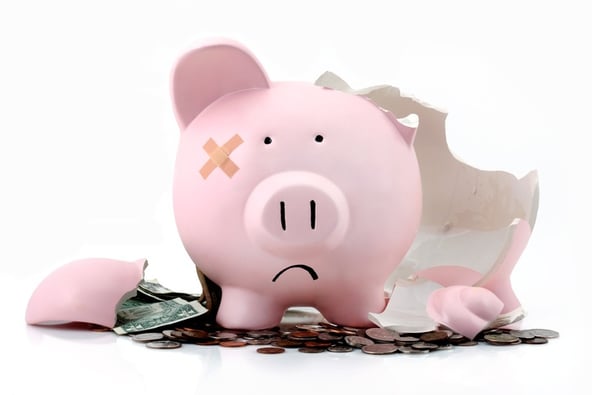
Poor customer service costs you the sales you already paid to get in the door.
Not loyalty points. Not sentiment. Countable sales, walking back out past merchandise you bought, in a store whose rent you already paid.
Here is the arithmetic on a single location.
What does poor customer service cost, in dollars?
Take 3,000 shoppers a month and a $100 average sale.
At a 12% close rate, that store does $36,000. At 20%, the same door, the same traffic, the same payroll, it does $60,000.
That is $24,000 a month. $288,000 a year.
You already spent the marketing money that brought all 3,000 of those people in. Service is the only variable that decides which of them leaves with a bag.
What poor service actually looks like on your floor
It is almost never rude. Rude would be easier to catch.
It is an associate calling hello from behind the register and going back to the task. It is a shopper walking the floor for four minutes without anyone learning a single thing about them. It is "let me know if you need anything," said to a back.
Silence is not neutral.
It is a choice with a price tag.
When we run an unannounced shop for a client, the heaviest section of the form asks whether anyone got to know the shopper as a person rather than a wallet. It is worth 440 points of a shop that runs over 1,000.
Most stores start at zero on it.
The three costs, in the order you feel them
Immediate. Lost conversions on traffic you already paid for. This is the $288,000 above and it happens this month.
Secondary. A lower average ticket. Nobody adds on to a sale they were not really part of, so your units per transaction sit flat no matter what you put by the register.
Delayed. Shoppers stop coming, and your best people leave. Selling is more fun than standing around, and the associates who wanted to sell go find somewhere they can.
What it looks like when a store fixes it
Polly's Gourmet Coffee had a Starbucks open 100 feet away. Mike did not cut prices. He trained his crew on how to treat the people already walking in.
Sales rose 50%. The Starbucks closed.
Bay Shores Peninsula Hotel trained its staff to build relationships instead of discounting rooms. It became number one in Newport Beach on TripAdvisor, then number one of more than 300 hotels across Orange County, ahead of luxury properties charging four times the rate.
Haute Links stopped discounting and started engaging. Comparable months went from $13,371 to $22,607. A 69% increase, with no change to the merchandise.
Quality Sewing & Vacuum raised sales per hour across 13 stores and watched customer complaints fall at the same time. Service and sales are not a trade-off. They are the same behavior.
None of those stores bought traffic. They stopped losing the traffic they had.
How do I fix poor customer service in my store?
Train the first ninety seconds, then measure it instead of hoping.
The first ninety seconds is where the sale is won or lost. Replace "can I help you find something" with a real greeting and one true observation about the person in front of you. Then get merchandise into their hands, and ask for the sale.
Then track close rate by associate. The spread between your best and your worst is usually enormous, and it is invisible until you look. MacSolutions Plus moved from 12% to 26% without adding traffic or payroll.
That is what our online retail sales training is built to do. Every client store gets an unannounced mystery shop before anyone trains, and another at six months, so the question stops being whether your crew liked the training and becomes whether the behaviors changed.
Across retailers running the program, 83% report double-digit growth within six months. You can read the full set of SalesRX case studies here.
For the wider picture on what service is supposed to do for a store, start with our guide to retail customer service.
What does poor customer service cost a retail store?
It costs the sales you already paid marketing to bring in. On a store seeing 3,000 shoppers a month with a $100 average sale, the gap between a 12% and a 20% close rate is $24,000 a month, or $288,000 a year, on identical traffic and identical payroll. The cost compounds through a lower average ticket, shoppers who stop returning, and the good associates who leave.
Is bad customer service really costing me sales, or is it the economy?
Count it yourself. Track how many people walk in and how many buy for one week. If your close rate is near 10% you have a floor problem, not an economy problem, and the floor is the part you control.
How much does it cost to fix?
Less than one month of the gap. The $288,000 above is the annual cost of doing nothing. Training a crew is a fraction of that, and the difference shows up in the close rate rather than in a feeling.
Should I discount to win customers back?
No. Discounting answers a question nobody asked. Shoppers who left unhelped did not leave over price, they left because nobody engaged them, and a sale sign does not fix silence. It just makes the silence cheaper.