

You train them to sell the room by teaching one sequence and making them practice it until it is automatic. Greet and build enough rapport that you earn the right to sell. Ask what changed in their life that brought them in. Show them the room that answer calls for, not the one piece they pointed at. Then ask for the sale. That is the whole job, and almost nobody does it, which is why the money is sitting on your floor right now. Oh, and don't forget to hold them accountable for doing what you taught them to do.
I have trained over a quarter million associates on this. Most furniture floors skip it because they train product first and hope selling shows up on its own. It does not.
How do you train an associate to sell the room, not just one piece?
Teach the four moves, then make them practice off the floor until they cannot get them wrong. Not a quiz they pass once. Reps, days of them-just like a sports player, before they ever touch a live customer.
Knowing is not doing.
The move that makes the difference is the presentation. Six months ago I bought a sofa and walked out without the salesperson ever showing me an end table, a coffee table, or a lamp. I know he was on commission and he still would not do his own job. Do not let that be your floor. Make presenting the room something no one is allowed to skip, coach it, and measure whether it happens.
What should a furniture sales associate say to greet a customer?
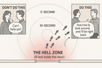
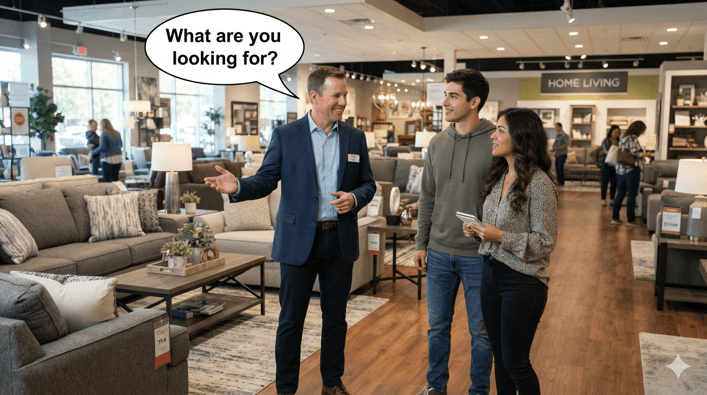
"Good morning." "Good afternoon." "Good evening." Then stop talking. That is it. No "What are you looking for," no "What's your budget," no "What color." All of those ask a stranger to commit before she feels safe, and they teach her to shut you down with, "Just looking."
Yes, it has to be the same greeting for everyone. Any owner, any manager, any new hire should know exactly how it sounds. It puts the customer at ease and, if you do it sincerely, it earns a thank you back.
"We each do it our own way" is not a process. It is lazy. Silence is even worse. Read your reviews. The number one complaint, by a mile, is "nobody greeted me."
Silence has a price tag.
Why do furniture shoppers say "Just looking"?
Because you asked for commitment. "Just looking" is not a mood, it is a reaction. You tried to pin her down before she had a second to breathe. She has twenty minutes before she picks up the kids, you asked her to name a product, so she put up a wall. Then most salespeople let her go with "let me know if you need anything," and she is gone. A sofa is a three-to-fifteen-thousand-dollar decision. It needs a person.
The merchandise cannot do it for you.
How do you sell the room instead of one piece?
Build enough rapport to earn the right to sell the furniture or mattress, then listen. When he mentions the last dining table never worked for Thanksgiving, a good salesperson files that mentally away and builds the whole room off it. An order-taker never hears it.
Then show him the store. Furniture and mattress showrooms are big and confusing, and half of what you carry nobody knows is there unless they ask. A ninety-second store tour fixes that and puts your best pieces in front of him. And start at the top. Walk him down from your best piece so he sees what changes as the price drops: the joinery, the materials, the time it took to build.
The salesperson who sells out of his own wallet starts at the bottom and never shows the ten-thousand-dollar set. Do the opposite.
What is a good close rate for a furniture store, and how do you measure it?
Most floors close around 9% of the people they greet. Owners swear it is higher. It is not, and you will not know until you count. Put a door counter in, tie it to your POS, and you have a real conversion rate. Dor runs about a hundred dollars a month.
Then do the math out loud. Three thousand visits a month, a $1,500 average sale, and an 8% close rate is $360,000. Take the same door count to 15% and it is $675,000. You already paid to get those people in. Everything you are not closing walks back out the front door. Move a floor from 12% to 26% and you are a hero, and you did not spend a dime more on traffic.
When should a furniture retailer bring in sales training?
When traffic is steady and the close rate will not move. That is the signal. If people keep coming in and the number sits still, the problem is your floor, not the market. Traffic is down and average tickets are up on tariffs, and the stores winning right now are the ones going back to being brilliant on the basics.
What does real furniture sales training look like?
It changes behavior. It does not hand out tired tips or closing scripts. "When they say this, say that" falls apart the second a real customer goes off the script, and furniture is nothing but off-script. A real program teaches a framework, the greeting, the rapport, the room, the ask, the follow-up, and lets the salesperson creatively play inside it. That is the backbone of furniture sales training for showroom associates.
Much like a movie, the order of events matters. Train the managers first, a month to six weeks. Then the crew, four to six months, because behavior only changes with practice. And you have to hold the line.
Train a new hire to greet the right way, let her hear three veterans say "Hey, what can I get you?" on Wednesday, and your training is dead by Friday.
That is what I built SalesRX to do. 83% of respondents who use it self-reported a double-digit sales jump inside six months. One furniture retailer told me it was 95% of what he would teach himself. That is why he bought it instead of building it himself. It is in 500 International Casual Furnishings Association showrooms.
Lee Vashe and his partner bought Big Island Living in Hawaii in 2023 with no retail experience and no idea where to start, about $655,000 on the books. They ran SalesRX, learned to build rapport, ask better questions, and sell on value instead of cutting price, and they went to $1.5 million in 2024, $2 million in 2025, and they are closing on $2.5 million this year. In his words: "Your approach works. It gave two first-time retail owners a practical sales system, the confidence to lead our team and a solid foundation from which to grow." Same store, same doors, a system.
Circle Furniture around Boston did the same. Richard Tubman used to be happy with a 5 - 8% month. Then he got 18, 20, 25%.
It is uncomfortable at first, which is how you know it is real. Bruce Jacobsen in Chicago put his crew through it and a twenty-year veteran told him "this is hard." He thought she meant her schedule. She meant everything she had done for two decades was getting rewired. His words: "She already is seeing a difference. I hear the difference in every approach. It's awesome." That is behavior training. It takes practice, and the owners who stay with it hear it on their own floor.
The bottom line
People have not changed. They still buy from someone they trust. Build the trust, run the framework every time, sell the room, ask for the sale, and show up at delivery to take a picture and bond again. Furniture is a considered purchase. Nobody wanders in for a sectional by accident. If they leave with nothing, a salesperson let them. That is your opportunity, and it is on your floor today.
Frequently asked questions
How do you train furniture associates to sell the whole room?
Teach four moves and practice off the floor: greet and let her settle, build rapport and ask what changed that brought her in, show the room that answer calls for, then ask for the sale. Make the presentation mandatory and count whether it happens.
Why do customers leave a furniture store without buying?
Because no one engaged them - even if it was their up. Shoppers often got a greeting from across a room, were left to "just look," expected to ask the salesperson any questions and walked. The traffic was yours. You lost it on the floor, not to a website.
How do you raise furniture showroom conversion without more traffic?
Close more of the people already walking in. Fix the greeting and the first ninety seconds, sell the room instead of the piece, and ask for the sale. Going from an 8% to a 15% close on the same doors can nearly double the month.
What is the best furniture sales training program?
Behavior-based training, not scripts and not product-only. A framework, managers trained first, the whole floor held to it, and months of practice. SalesRX and this furniture post lay out the system.