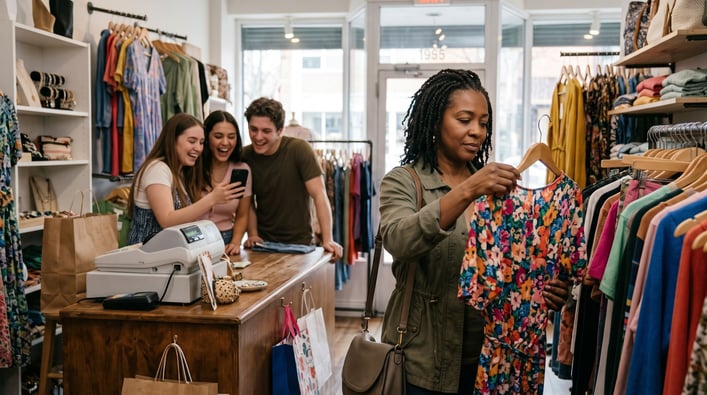


More often than retailers believe. In the unannounced mystery shops my team runs before any client trains, shoppers were ignored at 7 of 12 stores, and first evaluations averaged 30%. I'm Bob Phibbs, the Retail Doctor, and this is what the data from those shops shows about what happens on a sales floor when no one from headquarters is watching.
How the shops work
Every client store gets an unannounced mystery shop before anyone trains, and another at six months. We shop the stores, not the individuals, so every result is a store result.
The shop runs around 1000 points and scores the behaviors that decide whether a stranger buys. Did the associate say good morning? Did they use a Window of Contact, my term for how to build rapport before anyone mentions product? Did they share something about themselves, explain features as benefits, paint a picture of an add-on, and more?
Items that don't apply to a visit are taken out of the possible total, never counted against the store. So every score is a percentage of the points that actually applied.
What first evaluations show
Across 12 first evaluations, scores averaged 30%, with a range from 6% to 54%.
At 7 of those 12 stores, the shopper was ignored.
The heaviest section of the shop is connection and personalization: 440 points, nearly half the total. Most floors start at zero on it. That's the part of the sale where an associate has to get out from behind the counter and build enough rapport for the shopper to feel at ease buying, and it's the part most stores never train.
What happens after training
The spread is wide, and the reason is consistent. Stores that worked the system moved from 46% to 95%, and one hit 100%. The average store that stopped using the system scored 24% on re-shop.
Training didn't separate those stores. What separated them was a manager who kept coaching the behaviors after the training ended.
What it means for your conversion rate
A shopper who is ignored can't be converted. If more than half your stores let a stranger walk the floor without a word, your conversion problem isn't traffic, price or the internet. It's the first minute.
At the register level, the same behaviors show up as sales. Across 67 customer organizations and 27,453 associates in 17 countries, 83% of SalesRX customers reported double-digit increases in average sale within six months, per the SalesRX methodology. Barkers and Max, 100 stores in New Zealand, saw an 11.5% average conversion lift, and up to 20% at some locations.
Training those behaviors and then measuring them with an unannounced shop is what SalesRX online retail sales training does. For the register numbers that sit alongside conversion, see retail sales strategies.
How often do store associates ignore shoppers?
In unannounced mystery shops run by Bob Phibbs, the Retail Doctor, shoppers were ignored at 7 of 12 stores on the first evaluation. Those first evaluations averaged 30%, with a range from 6% to 54%.
What does a retail mystery shop measure?
A SalesRX mystery shop scores the selling behaviors that decide whether a stranger buys: the greeting, a Window of Contact to build rapport, engagement techniques, features explained as benefits, and an add-on. Connection and personalization is the heaviest section, worth 440 points of a shop that runs over 900.
Does sales training change what associates do on the floor?
When managers keep coaching it, yes. Stores that worked the system moved from 46% to 95%, and one hit 100%. Stores that stopped using it averaged 24% on re-shop, which is why every client store is shopped again at six months.