Do Shoppers Want to Be Left Alone in Stores?

Subscribe to our newsletter


No. Shoppers want to be left alone by an associate who opens with "Can I help you find anything?" They welcome one who earns their trust in order: a greeting, a personal connection, then one question about what brought them in. Skip those steps and you get brushed off, and your associate decides nobody wants help.
Don't 95% of shoppers want to be left alone?
That number comes from a 2018 HRC Retail Advisory survey, and it gets repeated as if it settled the question. Read it again. Shoppers said they'd rather be left alone than get the help they were getting.
Two years before that survey, a Mindtree study reported by the same outlet found the opposite. Shoppers who talked with an associate were more likely to buy, and their transactions were worth 81% more. 40% of shoppers couldn't find an associate when they needed one.
The newer numbers are worse for the leave-them-alone crowd. In a 2025 KPMG survey of 1,522 shoppers, only two in five believe store staff can answer their questions well.
Yet 90% said they would go back to a store where they got exceptional service from knowledgeable staff. Among electronics shoppers, 48% said better informed staff would improve the trip.
A Harris Poll survey of 2,102 US adults found the same pull. 62% named helpful employees as one of the things that makes a shopping trip good, and 73% said retail workers improved their experience.
Read those together. Shoppers want help and don't expect to get it.
That's not a verdict on help.
It's a verdict on your floor.
What happened to Sephora's red and black baskets?
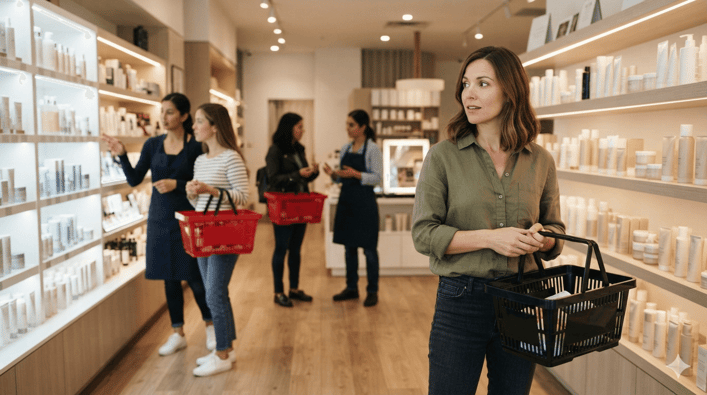
In 2019, a shopper photographed two stacks of baskets at a Sephora in Europe. Red said "I would like to be assisted." Black said "I would like to shop on my own."
The internet loved it. Most of the replies came from people tired of being asked over and over whether they needed help.
Look at what the black basket really says...
It's not "Leave me alone."
It's "Don't ask me if I need help."
Those shoppers weren't avoiding help. They were avoiding the question.
And the basket has a flaw. The shopper who grabs black at the door and has a question in aisle four has to walk back and trade it in.
Nobody does.
Seven years later, I couldn't find any of those baskets in Sephora stores.
Sephora solved the wrong problem. The fix isn't a basket.
It's an associate who never makes the shopper choose.
Why do sales associates stop approaching customers?
Because your associates trained themselves to believe nobody wants help.
The associate asks, "Can I help you find anything?"
The shopper says, "Just looking."
The associate walks away and files it as proof.
After a hundred of those, the associate stops approaching at all. Customers haven't changed. What changed is that nobody offers help worth taking.
When we send unannounced mystery shoppers into stores before training, first evaluations average 30%, and shoppers were ignored at 7 of 12 stores.
Here's what's missing. The associate who opens one gate expects the next one to open.
She expects the shoe to come off. She expects to hear "I'll take it."
Anticipation is part of the job, and almost nobody trains for it. An associate who expects nothing telegraphs it, and the shopper reads it before anyone says a word.
I saw it at a client eight months into SalesRX. One associate scored 100% on a mystery shop. I called the store expecting to congratulate the manager, who'd been there the longest.
It was a new employee.
He still looked forward to meeting people, and he'd learned the framework for what to do next.
Why does "Can I help you?" fail?
Because it asks for the end of the sale at the front door.
To say yes, the shopper has to tell a stranger what they want before they know whether that stranger is worth telling. So they say no.
If they'd wanted that experience, they would have simply bought it online. Yes, they could have researched the product.
But they still came into a brick-and-mortar store in a discovery mindset.
We shopped a workwear store this month. An associate walked up, pulled down a pair of shoes, and showed them to our shopper.
Then she disappeared.
She never came back. That store scored zero on the store tour, zero on product presentation, and zero on add-ons.
She led with product before she knew one thing about the shopper. Once the shoes were in the shopper's hands, she had nothing left to say.
A sale works like a canal lock. The gate ahead of you won't open until the water rises to match it.
The water is trust.
"Can I help you?" tries to open that gate at the front door. Leading with product tries in the aisle. Neither one works, because the water is still down.
How do you approach a customer who wants to be left alone?
Open five gates in order, starting with "Good morning." Nobody has to pick a basket.
Forget your store for a second and think about how you shop. I walked into Harry Rosen, the Canadian menswear chain, looking for a new outfit for my travel to China for my keynote last November.
I scanned first. Do the people look like they like working here? Do I feel welcome? Did someone speak to me?
If they do, I relax and browse. I touch the merchandise and think about how it might work. I'm still keeping my guard up. I'm not looking to be closed.
Only then do I try it on, sit down in it, or ask how to care for it. That's when I start seeing it in my home.
I can't get to that stage without the first two.
Your associate's five gates line up with those three stages. Each gate gives you an answer, and you need every one of them by the time the shopper says, "I'll take it."
Welcome
Gate one: "Good morning."
The answer: they say it back. Now they'll talk to you.
Gate two: the Window of Contact. A comment on something personal and unrelated to the merchandise, paired with something honest about yourself.
The answer: something about them that has nothing to do with your store. Now you've earned a real question.
Browse
Gate three: one general question, like "What's changing in your life that brought you in today?"
The answer: the reason behind the visit. The new house. The anniversary. That's what they really want, not what they said they could afford.
Then ask the question nobody else is willing to ask. "Why aren't you buying this online?" Or, "Why not from the store down the street?"
Only a professional asks that. The answer tells you what matters to them: they want to see it and feel it, or they saw it online and want someone to tell them it's right.
Ask it during discovery and you get information. Wait until the end and you get an objection.
Proactive or reactive.
Your associate picks one.
Buy
Gate four: features and benefits tied to that reason, with the product in their hands.
Know what game you're playing. In a shoe store, I want to see your sock. If you trust me enough to take off your shoe, I'll get one of mine on your foot.
In apparel, the game is getting you half naked in the fitting room. In furniture, it's the shopper sitting on the sofa instead of walking around it. Until they touch it, it's as far away as a picture online.
The answer: they sit, try it on, or slide the ring on, and they ask how to care for it. They start to see it in their home.
When your associates don't know the game, they play a different one.
Get rid of the shopper politely.
That's how merchandise sits.
Gate five: close with an add-on.
The answer: "I'll take it."
The associate who jumps from gate one to gate four is pushing against a closed gate. The shopper feels the pressure and leaves.
Here's how to find your problem. The next time a shopper walks out without buying, ask your associate four questions.
What did they say back?
What did you learn about them?
What brought them in today?
Did they sit in it, try it on, or hold it?
The first blank answer is the gate your team can't open.
Why do customers say it's too expensive?
Because the associate skipped a gate, and now they have nothing to work with.
There's a 1989 episode of The Twilight Zone called "The Mind of Simon Foster." A broke man sells his memories to a pawnbroker, one at a time, for rent money. His high school graduation goes first.
It doesn't seem to matter.
Then he lands a job interview. The interviewer asks where he went to college and what he studied, and he can't answer. He sold the memories he needed to get the job.
That's your associate when the shopper should be saying, "I'll take it." The gates were supposed to hand them the reason behind the visit and what the shopper really wants, not just what they said they could afford.
Skip them, and when the shopper says "It's too expensive," your associate reaches for the answer.
There's nothing there.
It's never about price.
It's the gate they skipped.
Great retail customer service starts with an associate who opens the gates in order. SalesRX+ trains associates to approach customers one gate at a time, then an unannounced mystery shop at baseline and again at six months measures whether the behavior changed.
Do shoppers want to be left alone in stores?
No. They want to be left alone by associates who ask "Can I help you find anything?" and welcome one who greets them, connects on something personal, and asks what brought them in.
Do customers want help from sales associates?
Yes, when the help starts with trust instead of a question they can say no to. In a 2025 KPMG survey, 90% said they would return to a store where knowledgeable staff gave them exceptional service, while only two in five believe store staff can answer their questions well.
Why do customers say "I'm just looking"?
Because the associate handed them the exit. "Can I help you find something?" has one correct answer, and it's no. Here's how to avoid hearing "I'm just looking".
What should retail employees say instead of "Can I help you?"
"Good morning," followed by a Window of Contact: a comment on something personal to the shopper, paired with something honest about yourself. Here's why "welcome in" isn't a greeting either.
-1.webp?width=102&height=111&name=IMG_2723%20(1)-1.webp)