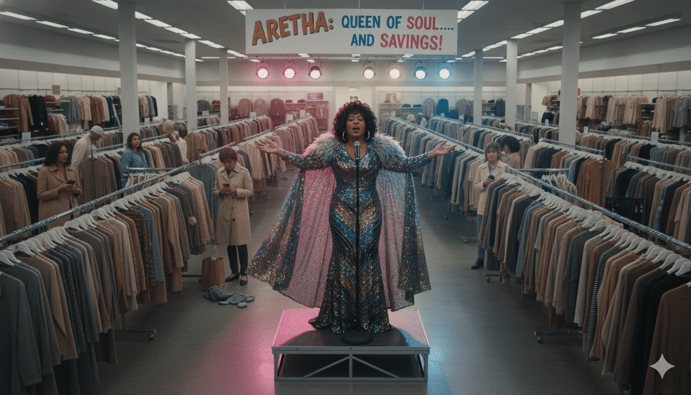
I was talking to my friend Kevin recently. He's a Broadway actor, and we got into a conversation about music - specifically, what made the women artists of the 60s and 70s so memorable.
Dionne Warwick. Diana Ross. Aretha Franklin. Barbra Streisand. Donna Summer.
Each one had a lane. You knew exactly what you were getting before the song started. They chose material that reinforced who they were, not just what was selling. That specificity is what made them icons.
Kevin's point was this: today's artists are often handed the same material as everyone else. A thumping single-chord track, someone belting over it. If you're already a fan, you can pick out your favorite. But if you're not? They all blur together.
I couldn't stop thinking about retail. But first, let me tell you what it actually cost those women to stay in their lanes.
They Said No
Aretha Franklin could have had a number one hit with Upside Down. Nile Rodgers and Bernard Edwards - the production team behind some of the biggest records of that era - brought it to her. She threw them out of her house.
"I didn't like his presentation," Aretha said later, laughing. "They wanted me to just sing it. I wanted to study it."
She passed. Diana Ross recorded it. It went to number one.
Aretha Franklin never had a number one pop hit with that song. And she was right to walk away from it. Because Upside Down is a Diana Ross record. It fits her lane - sleek, polished, produced within an inch of its life. On Aretha it would have felt like a costume. She knew that before anyone played her a note.
Dionne Warwick had a similar moment with Do You Know the Way to San Jose. She hated it. The lyric had a string of "whoa whoa whoas" that she couldn't stomach. Her songwriting partner Hal David had written it for her and she told him exactly what she thought.
"I said to him, 'How could you?'" Warwick recalled. She recorded it anyway - out of loyalty to David, not because she believed in it. It became one of her signature hits. She laughs about it now. "I cried all the way to the bank."
But here's the part that matters. Warwick's real identity wasn't built on San Jose. It was built on Walk on By, I Say a Little Prayer, I'll Never Fall in Love Again. Those Bacharach-David collaborations defined her so completely that decades later, no matter who else has recorded them, they still belong to her.
"They're definitely my songs," she says. "Even with the multitude of others singing those songs, they still know whose song it really is."
That's what a lane produces. Not just recognition - ownership. The kind that survives covers, samples, and fifty years of other artists taking a run at your material.
These women didn't stumble into their identities. They protected them. Sometimes at commercial cost. Sometimes against the advice of the people paying them. They understood something that most retail executives today have forgotten: saying no to the wrong material is as important as saying yes to the right material.
When Did Every Store Start Sounding the Same?
Walk through the men's department in any major store right now. Gray. Beige. Tan. The same palette repeated at every price point. A $400 pair of jeans and a $20 pair of jeans are making the same statement - which is no statement at all.
The merchandise lost its lane.
Your Store Has the Same Problem
Now walk into Macy's today. Then Bloomingdale's. Then Nordstrom. Then Target. Each one built its pricing on a promise - that you would be treated differently, served better, made to feel the price was worth it. Or due to the low cost, you would be on your own.
Bloomingdale's in its prime was a destination. In the 1970s and 80s it introduced Americans to European designer fashion. It had a point of view. You went there because it stood for something specific - fashion forwardness, a certain aspirational energy, a New York sensibility you couldn't find anywhere else. It wasn't trying to be Macy's. It wasn't trying to be Saks. It had a lane. And that lane justified the price.
Now walk in. Find an associate. Notice what happens.
The service behaviors are the same. The opening line is the same. The level of attention is the same across all four stores. Which means the price premium has nothing left to stand on.
That's not a store design problem. That's not a merchandise problem. That's a service level problem - and it starts with associates who were never taught what the brand actually promises.
That's not a trend failure. That's a brand identity failure. When you don't decide what you stand for, you follow whatever everyone else is doing. And you disappear.
The Problem Starts in the Boardroom
A lane isn't built on the floor. It's built in the boardroom. Your associates can't project a brand identity that leadership never defined. They'll default to the only script they know - "Can I help you find something?" - and wonder why the customer walks away.
The great retailers of the past didn't happen into their identities. Someone decided. Someone drew a line and said: this is what we are, and this is what we are not. That decision showed up in what they carried, how their people talked to customers, what they refused to put on promotion.
Nobody seems to be making that decision anymore. They're just hoping they have enough people to cover their shifts.
Nobody Gave Them Voice Lessons
And it shows up exactly where it hurts most - in the first five seconds a customer walks in.
Aretha didn't walk on stage and wait for the audience to come to her. She opened her mouth and the room changed. Your associates are doing the retail equivalent of standing in the wings.
Nobody taught them how to start a conversation. Nobody gave them voice lessons. Think about what that means for a moment. Aretha Franklin spent years studying her craft - not just singing, but understanding what kind of singer she was and wasn't. She knew her instrument well enough to throw a hit record out of her house because it didn't fit.
Your associates are handed a name tag and pointed at the floor.
The skill of starting a genuine conversation with a stranger - of opening your mouth and making the room change - doesn't develop on its own. It atrophies without practice. For most associates it was never built in the first place. They were never shown what it looks like to approach a customer with confidence and intention, to say something that opens a door instead of closing one.
A customer walks in. They're browsing. They're not making eye contact. An associate glances up, goes back to folding. Nothing happens. The customer leaves. The associate didn't fail because they were lazy. They failed because nobody defined what success looks like in that moment - and nobody practiced it with them until it became instinct.
That's a training failure. But before it's a training failure, it's a leadership failure. You can't train associates to express an identity that doesn't exist.
A brand without a lane produces associates without a voice. Both problems start in the same place.
So What's Your Lane?
Pick a retailer you admire. Describe them in one sentence - no "great service," no "wide selection." What's their lane?
If you can answer that easily, they've done the work. If you're struggling, they haven't. And if you're sitting in a leadership role right now trying to answer that question about your own brand - that's where the work starts.
Aretha knew what she was. She knew it well enough to turn down a number one hit to protect it.
Do you know what your store is?