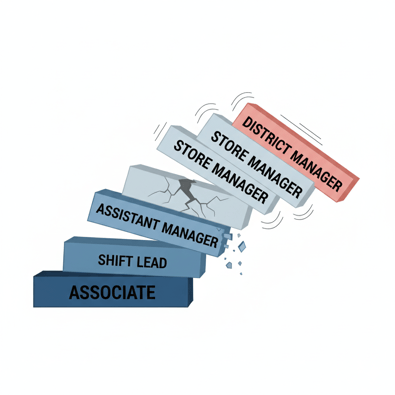


Your store manager is buried.
They're unpacking boxes at 6 AM, fixing the display that nobody else can seem to get right, covering a call-out on the register, and trying to squeeze in interviews for the third assistant manager who quit this year. Meanwhile, nobody on the team is being developed, performance is slipping, and your best people are quietly looking for jobs elsewhere because they see no path forward.
Sound familiar?
Ask yourself: If your store manager quit tomorrow, how many people on your team could step into that role next week? If the answer is zero, keep reading.
Here's the brutal truth: your manager isn't bad at their job. They're drowning because nobody below them was trained to handle what should be their responsibilities. And they're drowning because nobody ever taught them the difference between doing the work and developing people who can do the work.
THE MANAGER TRAP
Most retail managers spend 80% of their time doing operations and 20% managing people. That ratio should be flipped.
A store manager's time should break down like this: 70% coaching and developing people, 20% monitoring and checking performance, and 10% doing the work themselves to model standards.
If your manager is spending more than 10% of their time doing operational tasks, they're not managing anymore. They're doing their assistant manager's job. Or worse...their associates'.
This isn't a time management problem. It's a training structure problem.
And it's a succession planning problem. Right now, if your store manager quit tomorrow, who would you promote? If the answer is "I don't know" or "I'd have to hire from outside," you don't have a bench. You have a hope-and-pray strategy.
THE SUCCESSION PLANNING GAP
Most retailers think about succession planning when someone gives notice. That's too late. Real succession planning means you always have two to three people ready for every key role in your organization. Not "might be ready someday." Ready now.
But here's where most retailers get stuck: they don't know how to identify who has management potential, and they don't have a systematic structure to develop those people.
So they end up promoting based on tenure ("she's been here the longest"), sales performance ("he's our top seller"), or desperation ("she's the only one who didn't say no"). That last one isn't really funny.
None of those is a good criterion for management.
Management requires a different skill set: the ability to coach, delegate, hold people accountable, analyze performance, be able to see what is going on on the sales floor at any time, and develop others. Those skills aren't built by being a great salesperson for five years. They're built through progressive training that starts the day someone walks in the door.
I saw this play out when I was CMO of It's a Grind Coffee, a 145-location franchise. One franchisee wanted out of her store, so she promoted her best barista to manager. She skipped the two-week deep-dive training we required for all new managers because she was in a hurry.
Two months later, the store was a mess, and the new manager quit. Why? She'd never coached anyone. Never delegated. Never analyzed performance or held people accountable. She just kept doing all the work herself until she burned out.
Compare that to Jill, one of our SalesRX clients. She went through three managers who looked great on paper but couldn't hold people accountable or develop their teams. Finally, she promoted someone from within who'd been systematically trained on coaching, delegation, and performance management.
That manager knew the difference between doing the work and developing people who could do the work. Sales jumped double digits within a few months. Same store. Different manager. The difference? One was trained to manage, the other wasn't.
Here's how to fix it.
THE REAL JOB OF A MANAGER
Before we can fix this, we have to get clear on what each layer of your organization should actually be doing. Sales associates sell and maintain standards. Shift leads run individual shifts and give real-time feedback to associates.
Assistant managers are teachers. They show people how to steam pants correctly, set up a promotional display, and clean a fitting room to standard. They re-teach when someone gets sloppy. They lead the operational portions of team meetings. When something breaks or looks wrong, they fix it or show someone else how to fix it. Their job is hands-on, technique-focused teaching.
Store managers are performance analysts. They look at why the store is 15% behind goal this week and what patterns are causing it. They run the strategic portions of meetings. They don't re-teach how to fold a shirt—they coach the assistant manager to teach that better. They analyze performance data, hold people accountable, and develop their assistant managers to think independently. Their job is elevated, strategic, and focused on the why behind the numbers.
District managers oversee 6-7 stores, visiting each location every six weeks. They develop store managers, spot patterns across multiple locations, and ensure consistency. They don't run individual stores—they develop the people who run stores.
Territory or regional directors manage 3-4 district managers (roughly 20-30 stores total). They're looking at territory-wide trends, identifying what's working across markets, and elevating strategic thinking.
When these roles blur, everybody suffers. The manager gets buried teaching basics they shouldn't be teaching. The assistant manager never learns to solve problems independently. District managers end up filling in at the store level instead of developing talent. And associates receive inconsistent training because no one has clear ownership or makes time for it.
Here's the fix: structure your training so skills build progressively at every level, and each layer knows exactly what they're responsible for teaching.
BUILDING THE TRAINING STRUCTURE
Start with six stages of training that take a new hire from "I don't know anything" to "I can run this store." Use a badge system to show progression. Stage 1 earns a red badge: "I'm brand new, don't ask me to do anything yet." This protects new hires from being thrown into situations they're not ready for. They learn basics—cleaning, stocking, paperwork, and greetings.
By Stage 3, they've passed a product knowledge test with 80% or higher and earned a yellow badge: "Caution: I know some things, but not everything." If they don't pass, they go home and study more. No shortcuts.
Stage 6 covers closing procedures and final details. Complete this and they earn a green badge: "I can do it all." They're fully trained—eligible for evaluation and a raise.
Each stage builds on the last. People prove competency before advancing. Nobody gets thrown on the register on day two. And at every stage, someone is responsible for teaching them.
This is where you start spotting your future leaders.
IDENTIFYING WHO TO DEVELOP
Not everyone wants to be a manager. But the people who do will show you through their actions during training.
Watch for these signals:
- They pass tests on the first try and ask clarifying questions that show they're thinking ahead. They don't just want to know what to do—they want to know why.
- They help without being asked. They notice when a display needs fixing or when a new hire looks lost, and they step in.
- They make other people better. Watch how they interact with newer employees. Do they share what they've learned? Do people naturally gravitate toward them for help?
- These are your future managers. Not because they sell the most. Because they demonstrate the behaviors you need in leadership.
Once you've identified them, tell them. "I see management potential in you. Here's the path." Then start developing them intentionally.
Now scale that same concept up the ladder. Shift leads practice 30-second coaching on the floor and catching people doing things right. Assistant managers learn 10-minute coaching conversations, how to re-teach technique, and how to lead portions of team meetings.
By the time someone becomes a store manager, they've already given thousands of pieces of feedback and run dozens of training sessions. You're elevating what they already know how to do.
That's how you build a bench. By building skills layer by layer, so that when it's time to promote, they're already doing 80% of the job.
THE RESULT: STOP HIRING MANAGERS FROM OUTSIDE
When your training has structure and you're developing people intentionally, four things happen:
First, you stop hiring managers from outside. This is huge. Every time you hire a manager externally, you send a message to your team: "We don't think any of you are good enough." That kills morale and drives your best people out the door.
But there's also a financial cost. Recruiting fees, job postings, and the time spent interviewing candidates who don't know your business. Then the 6-month ramp period, where they're learning your products, your customers, and your standards.
And the 50% chance they don't work out, and you start over. Compare that to promoting someone who's been systematically developed, already knows your operation, and has proven they can do the job. The ROI is obvious.
When you promote from within, you signal that growth is possible, loyalty is rewarded, and there's a real path forward. Your team sees proof that someone who started as an associate three years ago is now running a store. That changes everything.
Second, your managers stop drowning and burning out. Here's what most people miss: it's not just about being overwhelmed with tasks.
When you give someone responsibility for 15 stores without the training structure to develop their teams, or you promote someone to manager without teaching them how to delegate, they don't just get busy—they burn out from a sense of helplessness. They can't affect change. They can't fix the problems they see.
They just keep working harder while performance stays flat. That's soul-crushing. When you build the training structure and keep span of control reasonable (6-7 stores per district manager, not 10+), managers can actually do their jobs.
They're no longer re-teaching basics because their assistant manager already handled it. They're no longer fixing every display because their team knows the standard. They can spend 70% of their time coaching and developing people because the operations are handled by people who were trained to handle them.
Third, your bench is always full. When you need to promote someone, you already know who's ready. They've been proving it for months through the badges they've earned and the skills they've demonstrated. You're not scrambling to post a job listing. You're not settling for whoever applies. You're promoting based on evidence. You have two to three people ready for every key role because you've been developing them systematically.
Fourth, your best people stop leaving. When someone asks "when will I be promoted?" you can show them exactly what they need to master. The path is visible. The expectations are clear.
Growth isn't a mystery that depends on your mood or who you like. It's a structure they can navigate. And when people see a clear path, they stick around to walk it.
Your job as the owner or district manager is to build that structure once, train your trainers to use it, and hold people accountable to it. No shortcuts. No promoting people before they've earned the badges. No letting managers stay buried because "that's just retail." And no hiring managers from outside when you have talented people internally who just need the right development.
This is how you build a retail organization that runs without you. This is how you develop managers from within instead of constantly recruiting strangers and hoping they work out. This is how you create a bench so deep that when someone leaves or gets promoted, you're not panicked—you're prepared.
HOW DO YOU KNOW YOUR MANAGERS ARE ACTUALLY COACHING?
You send a stranger in.
A full bench and a floor that sells are two different achievements. You can promote from within flawlessly, hand out every badge, and still have a manager who never corrects a weak greeting because correcting people is uncomfortable. Badges prove somebody was trained. They prove nothing about what happens at 2pm on a Saturday.
So measure the floor, not the org chart. An unannounced shop scores whether your associate said good morning, opened with a window of contact, shared a personal story, gave the store tour, explained features versus benefits, and painted a picture of an add-on. Every one of those is black and white, and every one of them is your manager's job to hold.
Interior Spaces in Ridgeland, Mississippi is what it looks like when a manager holds it. The store’s first unannounced shop came back at 46%. A later shop came back at 95%.
Note what is being measured. The store, not one person. A different associate was on the floor each time, which is exactly the point. You are testing whether the standard holds when you are not there. She did not do that with a coaching workshop. She ran the training cycle after cycle and held the line, and it took hold once her crew saw she was serious.
When the results come back, follow the order. Leadership team first. Then a private meeting with the people who were on the floor, reviewing who did what and when, good and bad, using Oreo mentoring. Only after those people have been coached do you share it with everybody, ideally in a store meeting, with identifying details removed.
Email a bad score to the whole team before anyone is coached and you have not measured anything. You have punished your floor, and it will be the last honest shop you get.
That is what SalesRX+ is built to do: train the selling behaviors, give your managers a specific standard to hold, then prove with an unannounced shop whether the floor changed. For the full sequence, see retail sales training.
START HERE: YOUR FIRST 30 DAYS
Don't try to build this entire system overnight. Start small and build momentum.
Focus on answering four fundamental questions for each role in your organization:
- What does success look like for this position?
- What training are we giving this person to achieve that success?
- Who's holding them accountable?
- How are we rewarding them?
If you can't answer those four questions clearly for your store manager role, you don't have a structure—you have chaos. Start there.
Week 1: Audit Your Bench
Write down every key role in your organization. Next to each one, list who could step into that role today if needed. Be honest. If you have zeros next to most roles, you know where you stand. Then answer the four questions above for your most critical role.
Week 2: Document Your Training Stages
Write out what a new hire needs to learn in their first 90 days. Break it into six stages. Don't overthink it. Start with what you wish every employee knew how to do. You can refine it later. Make sure each stage connects to what success looks like.
Week 3: Identify and Tell Your High Potentials
Pick your top three people who show management potential. Have a conversation with each one. "I see leadership ability in you. Here's what the path looks like. Are you interested?" Most people have never been told they have potential. This conversation alone will change your retention.
Week 4: Start Using the Badge System
I covered this extensively in my book, The Retail Doctor's Guide to Growing Your Business (Wiley.) Implement the red/yellow/green badge system for your next new hire. Train them through Stage 1 using your documented process. Watch what happens when everyone knows exactly where a new person is in their development.
Don't wait until you have the perfect system. Start with what you can control today.
Structure your training. Identify your high potentials early. Define the layers. Build the skills progressively at every level. Then watch your managers stop drowning and start developing the next generation of leaders.
Because when you stop doing everything yourself and start developing people systematically, you finally have time to build something that lasts.