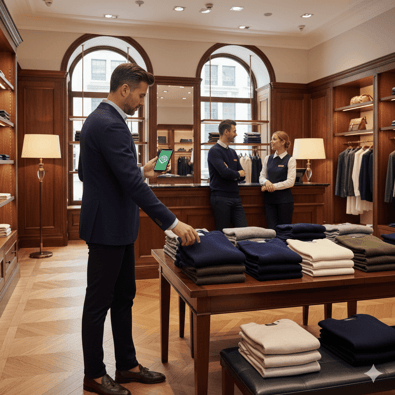


Retail associates have approximately 15 seconds to greet a customer. But that customer can get an answer from ChatGPT in just10. The majority of sales are lost in a store because shoppers are never greeted at all, and the longer someone goes unacknowledged, the less likely they are to buy.
The 2026 Problem: Employees Think They Have Time
The most common complaint we hear about associates in boutiques and department stores is that they're on their phones. They don't even look up to say hello. The conceit behind this behavior is that they think they have time. They operate like it's the 1950s and customers will eventually walk over to ask for help.
That's because in those days, the only place you could find out information was from a well-trained employee. Those days are gone since Steve Jobs introduced the iPhone about twenty years ago.
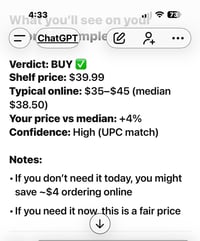 And it's important to understand we're not just talking about ChatGPT. We're talking about custom GPTs. Customers can load their own search preferences, their own criteria, their own priorities. The AI already knows what they care about before they even ask the question.
The challenge for retailers goes deeper.
Even if an employee uses ChatGPT to research something on their own device, their results will be shaped by their own previous prompts and history. They won't see what the customer sees.
Two people asking the same question get different answers based on their context. It becomes nearly impossible to anticipate or counter what the AI is telling your customer.
Just ten years ago, when a sale was lost, you could at least understand why. The employee could tell you: "She came in looking for a skirt. I showed her this one but she said it was too much money. Then I showed her the one on sale but we didn't have her size." You had visibility into why the customer didn't purchase from you.
That visibility is gone.
When a customer is exploring on their own and feels alone, they pull out their phone. They open ChatGPT, take a picture of the product, and ask: "Is this a good value? Should I buy this? Is there a better one online?"
In those seconds, the sale is lost.
By the time the employee finally looks up from their phone, the window is closed. The customer has already received a recommendation from an AI that the retailer will never see, never influence, and never counter.
That should scare the daylights out of you if you care about making a profit in your retail business.
Why Retail Associates Can't Answer Questions Without a Screen
This vulnerability didn't happen overnight. Retailers have been hollowing out associate knowledge - not just product knowledge - for years.
When mobile devices entered stores, employees stopped learning whether products were in the back room. They just opened a browser and checked the inventory system. They stopped learning product details because they could look them up. They stopped knowing prices because the screen would tell them.
Each shortcut made sense in isolation. Why memorize stock levels when you can check? Why learn specs when they're a tap away?
Associates became screen-readers instead of product experts. They lost the ability to answer questions without a device in hand. They lost the instinct to engage because the device became their first response to any uncertainty. And most had zero training how to speak to a stranger to begin with...
Now customers have better devices with better access. Unless the associate is using their own smartphone, that store-provided technology is probably years behind. And the customer's AI is faster.
And there's another problem. Since COVID, a lot of retailers have convinced themselves they can be down four or five associates on a shift and no one will notice. So now you have fewer people, less trained, with less understanding of how the game of retail needs to be played.
This will show up in punishing numbers in subsequent years. And when it does, people will look around and say "brick and mortar is dead."
No. You just didn't decide to fight for that customer.
ChatGPT Is Showrooming on Steroids: Instant Answers Replace Search
Before smartphones, you might have had a couple of minutes of patience from customers. Shopping was an event. People wanted to settle in and browse. The friction of driving elsewhere bought you time.
Once the iPhone entered the picture, stores became showrooms. Customers could touch products in your store, then buy online. Retailers panicked about price matching and competitive transparency.
ChatGPT is showrooming on steroids.
The customer no longer has to search, scroll, and interpret results. They take a picture or ask a question and get a direct answer. The AI synthesizes reviews, compares prices, and suggests alternatives in seconds.
And those results might be sponsored by Walmart or Amazon or any competitor willing to pay.
AI recommendations are increasingly subsidized by advertising. When your customer asks ChatGPT whether to buy the item in front of them, the answer may come with a paid suggestion to buy somewhere else.
Retailers cannot see what the AI recommends. They cannot influence the response. They only see the customer leave.
Why Luxury Retailers Are Most Vulnerable to AI Shopping Assistants
The stores most vulnerable to this shift are the ones charging the most for "service."
I've walked into luxury retailers where the price tags assume a certain level of attention. $400 shirts. $20,000 watches. $5000 handbags. The premium is supposed to include expertise, guidance, and care.
Instead, I've watched associates huddle at counters discussing weekend plans while customers browse alone. I've seen staff avoid eye contact to avoid having to help. I've had an associate look directly at me while I was wearing the brand of the department I was standing in, make eye contact, and then turn away.
The exact opposite of what justifies those prices.
These stores are most exposed because the gap between promise and delivery is widest. A customer paying luxury prices while being ignored has every reason to consult ChatGPT. And ChatGPT will happily suggest alternatives that don't require being treated like an inconvenience.
The custom GPT might also tell them they can buy the same item used from another retailer for much less. Or that a competitor has it on sale. Or that the brand isn't worth the premium in the first place.
The $19-an-hour associate chatting at the counter really costing the store thousands in missed sales. And the customer never complains. They just leave.
Store Associates May Be the Last Unsponsored Recommendation Left
Here's what most retailers don't realize: their associates may be the only unsponsored recommendation left.
ChatGPT is taking ads. Google search results have been pay-to-play for years. Influencer recommendations are sponsored. Every suggestion a customer receives online comes with an agenda they have to decode.
A trained store associate has no algorithm. No sponsor. No affiliate link. They can give a straight answer about whether something is worth buying.
But that's only true if they're actually trained.
If we assume employees are your most important asset, then yes, this is a competitive advantage waiting to be used.
Learning and development has become an afterthought. Some retailers operate on the assumption that they train once and it lasts forever. They check a box to say they did something with training when it's clear from the sales floor that they didn't.
Because of that, a lot of sales employees become brain dead. They lose the hustle. They lose the fun of making a retail sale. They become order-takers waiting for customers to tell them what they want instead of guides helping customers discover what they need.
I know this because I work with some of the best retailers in the world who are doing it right. The difference between a trained floor and an untrained floor is visible within seconds of walking in. The energy is different. The engagement is different. The results are different.
When a customer asks your associate a question, they could be getting something they can't get anywhere else: an unsponsored opinion from someone who has handled the product, seen how it holds up, and watched what other customers chose.
But only if that associate is trained, attentive, and available. If they're on their phone at the counter, the customer will just ask their phone instead.
The Data on Greeting Timing and Conversion
Let me be clear: I'm not advocating that you run up to every potential shopper who walks in your store within 10 seconds. That's pouncing, and customers hate it.
But 15 seconds is not as short as it sounds. Time it yourself. You can usually walk from the front to the back of most stores in 15 seconds. That's enough time to make eye contact, acknowledge someone's presence, and let them know you're available without ambushing them at the door.
Research across hundreds of retail stores shows consistent patterns:
- Customers greeted within 15 seconds convert at significantly higher rates
- The greeting window starts when the customer clears the entrance decompression zone, approximately 8 feet into the store
- Delayed greetings correlate with increased "just looking" responses and lower engagement
- Stores implementing structured greeting protocols see conversion improvements of 15 to 30 percent within 60 days
What Retailers Should Do
Recognize the window has changed. The time between customer interest and AI consultation is now measured in seconds. Staff positioning, phone policies, and greeting standards all need to reflect this new reality.
Rebuild product knowledge. If your associates can't answer basic questions without checking a screen, they offer no advantage over the customer's own device. Product training has to mean something again.
Audit the floor. Stand near your entrance for 30 minutes. Count how long customers browse before acknowledgment. If it's more than 15 seconds, you're losing sales to AI you'll never see.
Invest in people, not just tech. The answer to AI competition is not more screens for employees. It's employees who can do what screens cannot: notice a customer, read their needs, and offer judgment that isn't for sale.
The 15-Second Window
You have 15 seconds to greet a customer. The AI in their pocket only needs 10 to answer their question.
Your associates think they have time. They don't.
Every moment of inattention is now a live auction where you're not even bidding. The customer asks, the AI answers, and the sale walks out the door while your employee is still looking at their phone.
The only counter to a personal AI shopping assistant is a personal human shopping assistant. One that notices the customer first.