

Updated September 20, 2026
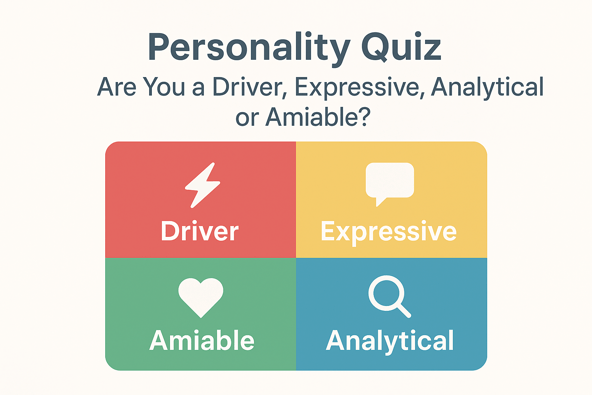
There are four personality styles: Driver, Expressive, Amiable and Analytical. Which one you are comes down to two questions: how hard do you push, and how much emotion do you show? Drivers push hard and show little. Expressives push hard and show plenty. Amiables hold back and show plenty. Analyticals hold back and show little. That is the entire model, and once you can see it, you can adjust to anyone who walks through your door.
In my 30+ years helping retailers, sales teams, and business owners, I've seen how understanding your personality style changes how you sell, lead, and connect with others. This quiz will show you which of the four you are, and how to use it starting on your next shift.
What Is the Personality Styles Quiz?
The Personality Styles Quiz sorts you into one of four styles based on how you behave where people can see it, not on how you feel inside. That is what makes it useful on a sales floor: you can read a stranger in under a minute without asking them a single question about themselves.
Psychologists David Merrill and Roger Reid built this model in the 1950s and 60s and called it Social Styles. They plotted people on two axes. The first is assertiveness, or how hard you push. The second is responsiveness, or how much emotion you let show. Put those two together and you get four quadrants. That is where the styles come from.
Unlike MBTI or DISC, which go deeper into what happens inside your head, this model stays on the surface on purpose. The surface is the part you can actually see in a customer.
- Results-focused
- Decisive and action-oriented
- Low tolerance for small talk
- Wants quick answers
- Outgoing and enthusiastic
- Talks with energy and gestures
- Enjoys storytelling
- Seeks recognition and approval
- Loyal and relationship-oriented
- Avoids conflict
- Seeks harmony and agreement
- Prefers emotional safety and reassurance
- Logical and data-driven
- Careful and methodical
- Wants proof and facts
- Needs time to evaluate decisions
Why Knowing Your Personality Style Matters
Knowing someone's style tells you how to talk to them, which is the difference between a customer who feels understood and one who walks out. Most associates run the same script at everyone: "What can I help you find today? It's over here. Ready to check out?" That lands with maybe a quarter of the people who hear it.
Once you can read styles, you can:
- Build rapport faster
- Communicate without friction
- Stop arguments before they start
- Hire people who fill gaps instead of copying you
- Coach each person the way they can actually hear it
Real-World Examples of Personality Styles in Retail
Here is what each style looks like walking through your door, and what to do about it.
Driver customer. They walk in, get to the point, and want fast answers. If you try to warm them up with small talk, you lose them. Give them facts, give them options, let them decide quickly.
Expressive customer. They open with a personal story and want to chat. Match their energy. Build some excitement into what you show them and they will give it back.
Amiable customer. They want reassurance, not pressure. Drop the hard sell. Build trust, guide gently, and understand they buy from people they feel connected to.
Analytical customer. They want data, details and time. Give them comparisons, specifications and your return policy. Let them process without rushing them. They buy once they feel fully informed.
Personality Styles Help Leaders Build Better Teams
Personality styles change how you hire, coach and settle conflict, because most team problems are style mismatches wearing a motivation costume. When a manager tells me "I just don't know how to reach them," the problem is almost never that the employee stopped caring.
- Hiring: build a balanced team with complementary strengths instead of four versions of yourself.
- Coaching: tailor feedback to how each person takes criticism. A Driver wants it in one sentence. An Amiable needs to know the relationship survives it.
- Conflict: recognize when two styles are colliding rather than two people.
- Team building: use styles to get people collaborating instead of grinding.
Are Personality Quizzes Scientific?
No personality test can fully define you, and this one does not try. These quizzes are self-assessments, which means your answers reflect how you see yourself on the day you take it. You also carry elements of all four styles and shift between them depending on who you are with.
That does not make the model useless. It makes it a lens rather than a label. The value is knowing which of your own strengths to lead with depending on the person in front of you.
How to Apply Your Personality Style Right Away
Three steps, starting on your next shift.
1. Observe, don't assume. Watch for:
- Speech speed and tone
- Body language
- How they open the conversation
2. Mirror their pace and language.
- Speak faster or slower to match them
- Match formality or informality
- Use their vocabulary, not yours
3. Practice with your team.
- Roleplay reading styles out loud
- Review real customer situations together
- Build confidence adjusting your approach live
Want to Go Deeper? SalesRX Builds These Skills for Real-World Selling
Reading a style takes a minute to understand and a while to do under pressure with a stranger in front of you. That gap is what training closes.
Inside SalesRX, I train retail associates, managers and owners to:
- Spot a style quickly when talking to a stranger
- Adjust the conversation in real time to build rapport faster
- Handle difficult customers without losing the sale
- Make selling feel natural, even for people who thought they weren't good at it
- Use the same skills outside work, where they also happen to help
If you have ever wished your team felt more comfortable starting conversations and building trust, retail sales training is how that happens.
Frequently Asked Questions About Personality Styles
Is this different from MBTI or DISC?
Yes. MBTI and DISC are more complex and focus on internal preferences. This model focuses on behavior you can observe and act on immediately, which is what makes it work in retail, sales and leadership.
Can I have more than one personality style?
Yes. Everyone has a dominant style but uses traits from all four depending on the situation. The point is not to put yourself in a box, it is to know which gear to shift into for the person in front of you.
How do I tell someone's style in under a minute?
Ask yourself the two questions the model is built on. Are they pushing hard or holding back? Are they showing emotion or keeping it flat? Fast and flat is a Driver. Fast and warm is an Expressive. Slow and warm is an Amiable. Slow and flat is an Analytical.
How does this help my retail sales team?
Associates who can read styles adjust to each customer instead of running one script at everyone. That builds trust faster, cuts friction, and improves conversion.
What if I read someone wrong?
You will, and it costs you very little. Styles are a starting guess, not a diagnosis. If your approach isn't landing, change pace and try the opposite. The customer will tell you within a sentence or two.
Does this apply to ecommerce too?
Partly. These styles work best face to face, where you can read pace and body language. Online, they can still shape how you structure product pages, chat and recommendations, since some shoppers want specifications and others want reassurance.
Take the Personality Styles Quiz
If you want to improve your sales, your leadership and your relationships, start by understanding yourself. The quiz takes a few minutes and tells you which of the four you are, with practical ways to use it.
Take the Personality Styles Quiz now.