

Updated November 5, 2026
You attract more customers by fixing what shoppers see before they walk in. Put your best merchandise at eye level in the window, frame the entrance in color, light the store so it looks open and new, and use signs that sell a want instead of a discount. Then train your crew to convert the traffic you earn.
Attracting foot traffic starts outside your store, not inside it. Before a customer ever sees your merchandise, your signage, windows, and curb appeal decide whether they walk in at all. Here are twelve ways to grab that attention and get more people through your door.
1. Create a Memorable Monument Sign for your Business
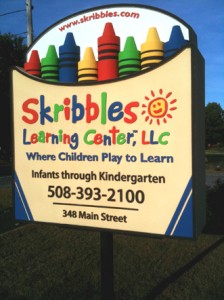
Signage for retail stores has to start at the curbside. Don't do what everyone else does with black block letters on a beige concrete sign.
While many developments have strict monument sign policies, reducing most businesses to a commodity by the road, think Jane's Fun Toys For Girls and Boys reduced to TOYS.
If you present a compelling sign, you can get away with it, as this learning center has done.
Who wouldn't think it would be fun to send their child there? Even better, consider digital signs that can change on a dime.
2. Make a Great Window Display
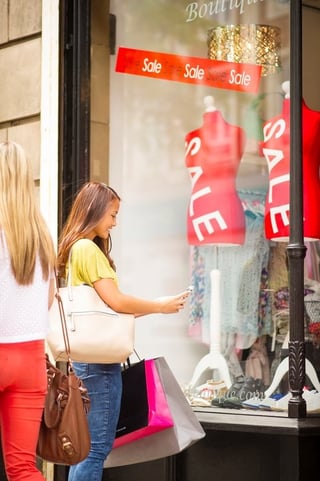
If you are in a popular destination with great foot traffic, create a store window that tells one story and tells it well. Your window display must be your invitation to enter.
A well-designed window display encourages impulse sales and piques the curiosity of a potential customer. It might even tug at their heartstrings.
A June display at a jewelry store featured a miniature park scene. Seated on one end of an oak bench a young woman held out her left hand as her fiancé, on bended knee, placed a sparkling platinum diamond ring on her finger. At the other end of the bench, an elderly woman, alone, admired her own wedding band. A simple sign overhead said, “A diamond is forever.”
Check out these pictures of a toy retailer with incredible visual merchandising skills.
3. Roll out a Red Welcome Mat

The best hoteliers and event producers know nothing screams "special treatment" like red welcome mats. A simple mat with Welcome on the front in a high-traffic area draws attention to your retail business.
When I was in New Zealand, I saw a florist who used red rose petals from old roses scattered across the sidewalk like a carpet to draw the attention of passersby to her beautiful windows and into her shop.
Beth Hnatio-Pumphrey with EJP Studios in Frederick, MD, suggests writing on the sidewalk with chalk. She advises drawing "arrows, cute sayings, types of items or lines you carry. It is different. People notice and it leads them to your door."
4. Put your Best Merchandise out front
Some retailers rotate merchandise outside so shoppers can browse in the open air. I don't recommend that, especially for apparel. Instead, rotate your best items in the front of your store every day.
If you sell vehicles, like a motorcycle dealer, know that nothing grabs speeding customers’ eyes faster than the display of a shiny new vehicle. And not the cheap one, but the one that turns heads and drives foot traffic because they see that you are the source of excitement.
5. Add custom parking lot signs
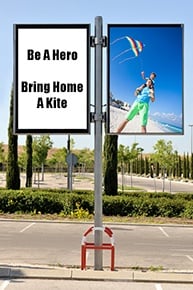 Light pole signs – You’ve seen these at gas stations and fast-food restaurants. Make sure these are printed in full color.
For example, a red product photo with text proclaiming, “Valentine's Day Is Coming,” and your logo at the bottom would be great for January. A picture of a child flying a kite with the words, "Be a hero, bring home a kite." You get the idea. The goal is to get away from screaming price all the time.
Speak with your landlord to see if there is an objection.
The idea with this type of sign is not to “sell” anything (Big Sales 20% off!) but to showcase your best product. Think something short like “Learn To Sew,” “The Perfect Birthday,” or “You Can Cook.”
6. Add pennant flags across your parking lot

A string of pennant flags from a light pole to the front of your business. You can get a multi-color version at sporting goods stores for under $50.
The trick with flags is to replace them about every other month while they are still bright and before they are all ripped.
7. Use murals on buildings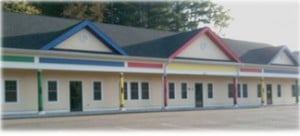
Notice how the children's learning center I discussed in point one, Skribbles, carried their fun theme to their building, too?
If you can make your building immediately recognizable for what you sell, have at it. If you can't, you can still put a tall banner from the roof to the sidewalk in eye-catching colors (think forest green instead of a garish fluorescent pink). At the top, put, “We’ve Got...” and add pictures of your best products.
Again, the goal is not to scream price but to showcase the wants. See if your vendors or even nearby businesses would cooperate to save money. City sign ordinances may seem not to allow, but check – usually, they will let you have it up for 90 days.
If you can't put it on the building, you can get freestanding banner holders to place by your doors. Placed outside, these are used where you cannot use a building banner but with the same message.
Costs for a weighted banner holder can be a couple of hundred dollars and can be changed monthly to refresh your image.
Check out a case study of how we made a retailer's entire store an advertisement.8. Use wicket yard signs
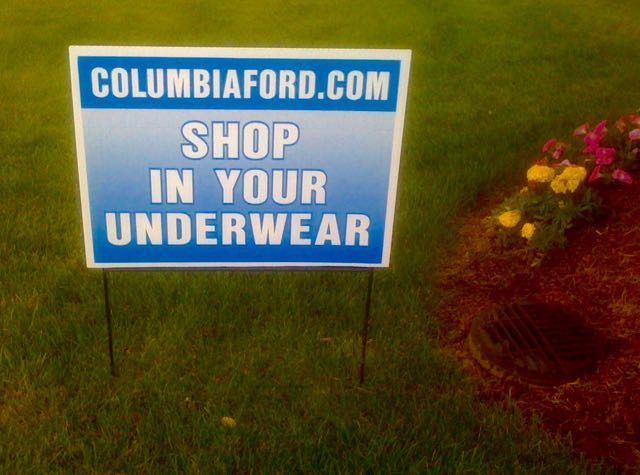
Wickets are lightweight signs often used by realtors for open houses because of their reasonable cost (less than $30 each). They are pushed into the ground and stand three feet high by two feet wide.
For a limited-time promotion, these might be a good choice for a small business owner to get your message out into your parking lot or next to the sidewalk of a busy intersection.
Some are sturdier than others, but they do not take much wind. Even if your city has sign police, these can generally be used on weekends when they’re off duty.
9. Add sandwich board signs
My Little Red Wagon in Hudson, Ohio, uses its portable sign to challenge its customers. Like this one: "Finish our 9-piece puzzle in less than 5 minutes and get a free puzzle!"
Others use them for a short bulleted list of benefits, a snappy saying, to catch the attention of their target market, or to draw attention to a hard-to-find item.
I spotted this A-frame sign showing their new protection plan.
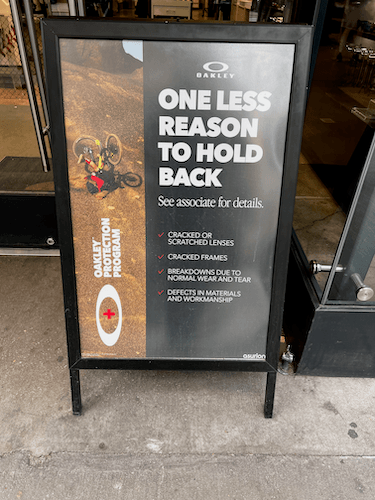 Using a professional curb sign like the MDI Windmaster gives your store’s message a professional look. Weatherproof with a base you can fill with sand, water, or anti-freeze, the Windmaster will last for years.
For under $300, you can use this important tool for high-quality color graphics to stand out from your competitors who write a generic “Sale” on an old slapped-together "A" frame sign.
Again, check with local authorities on signage regulations. I've seen some clients only use them on weekends when the sign inspector is off but when foot traffic is highest.
10. Use colorful landscaping and planter boxes
One of the most successful restaurants in California spends very little on ads but a bundle on the landscaping around their restaurants. There is no patch of earth that does not bloom throughout the year.
Why do they do this? Because they know their abundance of flowers will attract customers’ eyes, everyone knows their location in town.
If you have nothing but sidewalks in front of you, plant up some large pots with something like bright red geraniums and keep them watered, fed, and well-maintained. In the winter, plant junipers and string lights on them.
Some of you think, “Guys won’t appreciate that.” Remember, guys are often the ones maintaining their yards.
11. Decorate your store exterior using balloons
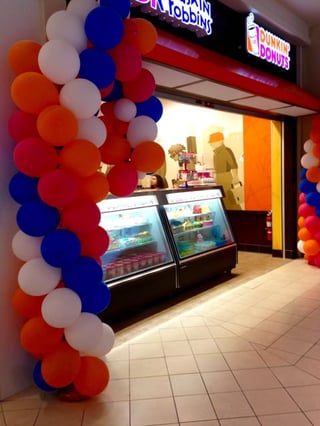 Nothing cheaper provides movement and attention to your business than balloons. Be sure to use plenty and replace often as helium deflates in the sun.
If you have a railing, use that.
If you have nowhere to tie them, you can use flat cinder blocks to tie the strings through the holes. If you dislike how cinder blocks look, disguise them with cloth, burlap, or oilcloth.
Don't forget, they also look great in malls. Just check with your management office first.
12. Use QR codes so shoppers can buy from you easily, even when you are closed.
QR codes are those square barcodes you scan to call up information. In a high-traffic retail area, these codes provide a shopper with product details - at night.
For example, a customer scans a QR code you've placed in your front window display. When you're closed or any time they walk by, they can scan or accept the beacon to go to your website and learn more about a product or order it directly from you.
One more tip to stand out from your competition is to make sure you have your parking lot patched and sealed every year– you have to look new and successful, not old and struggling.
When you make yourself look bigger and feature our wants and desires, you’ll pique our interest in what you have waiting inside.
See also, 10 Ways to Merchandise the Inside of Your Store
Where should the most important item go in a window display?
Right at the passing shopper's eye level, which is usually about six feet up. To find it, put one person inside the window and have another walk down the sidewalk. The person outside says where their eyes land, and the person inside marks that spot on the glass with a Sharpie.
Build the whole display at that level, a little above and a little below. The premium piece goes right on the mark - the brightest, most beautiful item you carry, not the cheap one. Then build a color story around it.
If your shoppers drive past instead of walk, have someone pull up and park out front so you can see where a driver's eyes land.
Most windows miss this. They're full of merchandise, but nothing tells the shopper where to look, so shopping feels like work and nobody comes in.
Short on cash for the window itself? Read How Do You Design a Store Window With No Budget?
How do you make a store entrance more inviting?
Frame the doorway so it's the brightest spot on your building. Look at most Chevy or Toyota dealers and you'll see a rectangle of bright color painted right around the doors. It tells shoppers where to come in, and it tells them this business is different.
You can do it with paint, with an addition to the building if your codes allow it, or with planters and a welcome mat. Then pair it with a companion window that gives them a reason to come inside and learn more.
Next, look at what's growing out front. A new restaurant opened near me and never changed the plantings - dry grasses and plants that looked dead. No color.
It looked closed.
Bright colors, seasonal flowers and lights at night work in California or New York, in spring or winter. Natural color attracts the eye, and the eye brings the customer.
What should a store sign say to get people to come in?
It should say what the shopper could do, not what's on sale. Customers are immune to "20% off this weekend only."
"You can cook," with one picture and a line about your classes, starts the shopper wondering what it would be like. That wonder is what propels them through your door.
Don't forget the signs nobody thinks about: the parking lot and the covered windows on the back or side of your building.
Are props worth the money in a retail display?
Yes. Budget at least $100 a month for props, even in your smallest store. But props are there to add interest or create a mood, not to hold whatever you happen to like.
The higher the price of your merchandise, the more temporary your props should look. For a spring window, plant real grass seed in colorful pots. Fake grass lasts forever, but it never looks the same, and real balloons beat fake ones for the same reason.
Watch the holiday windows. A Fourth of July window with so many flags and streamers that it advertises the holiday instead of your merchandise is wasted glass.
A Lifestyles of Saratoga window I saw used three yellow watering cans placed around a single shirt. The cans caught your eye, and the shirt is what you remembered.
That's a prop doing its job.
Does store lighting affect sales?
Yes. People are attracted by light, and a dark, dingy store telegraphs that nothing new is going on here. LEDs have brought the cost down so far that lighting is one of the most cost-effective upgrades you can make, including lights under your shelves.
Walk your store today and note every dark area. Then visit a newer store - a recent Verizon, AT&T, CVS or Walmart - and look at how they light their aisles.
Then call an electrician.
What makes a display sell once shoppers are inside?
Getting shoppers to feel, touch or hold the merchandise. People who touch a product are much more likely to buy it, so take one piece off the display and hand it over. "How does this feel against your skin?" "Notice how lightweight this is."
Most shoppers haven't made up their minds when they walk in. Frank Mayer and Associates, a display maker, commissioned the 2026 In-Store Retail Display Influence Report, a survey of 1,119 U.S. consumers in January 2026. 92% said they sometimes, usually or always buy items they didn't intend to buy, and over 60% said a display influenced their choice between similar products.
Movement helps too. If a display isn't moving merchandise, add a train or lights so people pause. Shoppers are jaded, they may have been in twice already, and a display that looks new will sell merchandise that isn't on sale.
And commit. A hot tub dealer who drops one orphan barbecue in the middle of the spas hasn't entered the outdoor living business. Buy enough to make a store within a store, merchandise it like someone's patio, and know your numbers: if you bring in $300,000 of a new category, how soon does it have to sell to pay you back?
Most of you don't need more merchandise. You need fewer SKUs, more compelling merchandise and Instagrammable displays, so it goes out the door instead of sitting on your walls and tables.
How do you attract customers to multiple stores?
Give every store the same standard and let each location adjust for its own sidewalk. Anthropologie sends a display kit to all its stores, each store can customize it, and a merchandising team teaches exactly what the look is.
That's the model whether you run five stores or fifty. The Sharpie test has to happen at every window, because a mall store, a strip center and a street-front store don't put the shopper's eyes in the same place.
Give each store manager the prop budget, the lighting walk and the planter schedule. Have your district manager start every visit at the curb, where the shopper starts, and take one photo from the front door the way I describe in What Do Customers Notice First When They Walk Into Your Store?
Whatever you send, teach people the proper way to use it, then budget accordingly. A dead planter at one location tells shoppers something about all of them.
Two ways to keep Customers Away from your door
1. Human directionals
Nothing looks more desperate than a sign twirler with a red arrow on the sidewalk pointing to the business. Your human directional may get attention, but customers think, “Poor guy.”
If your location is that hidden, you should have thought of that before you opened. You don’t want to be 100 feet from success.
The people chosen for sign wavers are typically the saddest looking people, bored, with headphones in their ears and their eyes vacantly looking into traffic; oftentimes with a cheap beach chair by their side.
Worse is using your kids. Is this the image you want for your business? No.
2. Garage sales
Sticking your old sale merchandise out onto the sidewalk looks like a garage sale. Those driving past will judge you by what you have chosen to represent your business out front, which is merchandise no one wanted, so you put it on sale.
Low-Hanging Fruits to Attract Attention to Your Store
These aren't all innovative ways to attract attention to your store, get more customers, and increase your retail sales, but they can give you an easy lift without a lot of cash outlay.
For what happens once they walk in, see my guide to how to merchandise a retail store, and for the window itself, the best way to create window displays that drive foot traffic into your store.
Common Questions About Attracting Retail Foot Traffic
Does running a discount or promotion bring in more foot traffic?
Discounting brings people in for the sale, not for your store. A strong storefront and window display works without training customers to wait for a markdown.
Do sign twirlers or clearance racks out front help?
No. Both read as desperate rather than inviting, a sign twirler looks like a business in trouble, and a sidewalk clearance rack looks like a yard sale.
Does my Google Business Profile matter if I'm focused on walk-in traffic?
Yes. Keeping your hours, photos, and address current on Google and Yelp is often the first place a nearby shopper checks before they ever reach your door.
What's a cheap way to make a store exterior stand out?
Balloons, pennant flags, or colorful landscaping. All are inexpensive, easy to refresh regularly, and effective at catching a passerby's eye.
What height should a window display be?
Build it at the passing shopper's eye level, usually about six feet up. Have someone outside mark where their eyes land on the glass, then put your best piece on that mark and build a little above and below it.
How much should a small store spend on display props?
At least $100 a month, even for the smallest stores. Spend it on props that create a mood and point to the merchandise, and make them look more temporary as your price point goes up.
Is store lighting worth the investment?
Yes. LED lighting costs far less than it used to, and light draws people in while dark aisles say nothing new is happening. Light the aisles and the shelves, then compare your store to a newer chain store nearby.
Why should customers touch the merchandise?
Shoppers who feel, touch or hold a product are much more likely to buy it. Take a piece off the display, hand it over and ask how it feels.
How do chains keep store exteriors consistent?
Send every store the same display kit and standard, teach managers how to use it, and let each location adjust for where its own shoppers look. District managers should check the entrance and window from the curb on every visit.
To really get more sales, you need to convert more lookers to buyers. My online retail sales training program SalesRX can help.
All the traffic in the world won't help if your crew lets it walk back out. SalesRX+ trains the selling behaviors that turn a shopper into a customer, then an unannounced mystery shop measures whether those behaviors changed in your store.