

Because your training apps teach product knowledge and task completion - not how to actually sell.
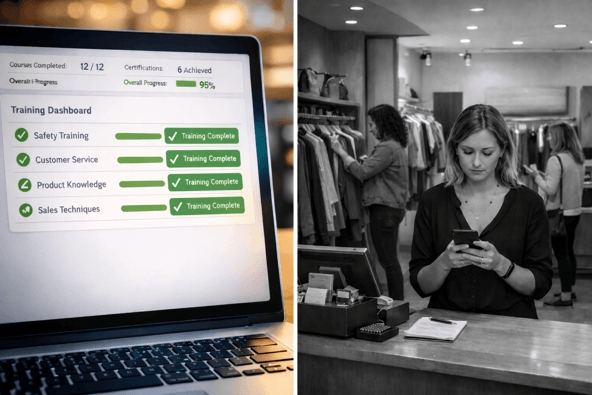
You're thinking: "We bought Zipline. We added Axonify. Everyone logs in. Completion rates are at 95%. So why are conversions and units per transaction still flat?"
Those apps solve knowing (product facts, compliance) and doing (tasks, execution). They don't solve becoming - turning associates into sellers through practice, failure, coaching, and repetition.
The Gap Costing You $500K Per Store:
- You have tools that distribute content (LMS, ops platforms)
- You're missing the framework that changes conversations
- Without role-play practice + manager coaching, training dies in 2 weeks
SalesRX clients see 10-20% lifts in UPT and transaction value
You've solved distribution - getting content to your team through apps and platforms. You haven't solved the part that actually changes what they say to customers. That gap is costing you half a million per store.
Retailers solve problems by adding tools.
Need better store communication? Add an ops platform. Need to track compliance? Add an LMS. Need to improve sales? Add a new celebrity line of merchandise.
Retailers all strive for foot traffic, but ignore the effect their untrained staff are having. Associates who would rather text than talk remove the wonder from browsers about what they could buy. How? Through inattentive service, saying the wrong things at the wrong time, or staying mute behind the counter.
Most retailers assume their existing tools handle sales training. They put product videos in the LMS. They add "greet customers in 30 seconds" to the task list. Box checked.
Others know they need something but aren't sure what. They send managers to a workshop, buy a sales book, or hire someone to do a training day. Either way, the result is the same: conversion and units per transaction barely move.
That's because at its core, most have removed the fact they need behavior training, not training.
Olivier Bron, CEO of Bloomingdale's, told McKinsey this summer: "I don't care how good a training is, it's all forgotten in two weeks." He's describing training.
Not behavior training.
SalesRX clients see lasting change because training is reinforced, coached, and the desired selling behaviors are applied on the floor where service and selling actually happen. That's behavior training - the difference between delivering content and building a framework.
The Problem Isn't Motivation - It's Method
Your associates want to learn fast. Most are gamers. They want to get through training, check the box, and move on. In games, you learn by trying, failing, and trying again until you win.
Unless you adopt that same gamer's mindset, they'll just go back to looking down at their screens from behind the counter instead of learning what they should do with customers.
Having that discussion with each individual about needing to look at training differently - that's a big leap for companies that haven't had a framework for selling their merchandise to begin with. Even if you convince them to try, you're fighting human nature.
In surveys, American adults cite lack of willpower as the top barrier to changing behavior. Around the world, when adults rate themselves on two dozen positive qualities, self-control ranks dead last.
Research also shows that exercising willpower feels awful, whether you're resisting something fun or forcing yourself to do something un-fun. That's why expecting associates to "just do better" after watching a video doesn't work.
Willpower isn't a training strategy. Frameworks are.
Neuroscience research published in the Journal of Experimental Psychology proves the best framework for stronger retention is spacing learning over time. Your brain needs recovery periods to move information from short-term to long-term memory. This is especially important when you are trying to overwrite your current long-term memory phrases like, "Anything I can help you find today?"
SalesRX breaks training into 10-minute, twice-weekly sessions designed for retention, not completion. Associates learn a technique, practice with AI coach Sidekick Rex who gives instant feedback, then verify the skill with their store manager in a mock session on the sales floor. Three training touchpoints - double the industry standard - that make SalesRX a retail performance program, not compliance training.
Without this structure, even motivated teams prove Olivier Bron right - they forget everything by their next shift. Training - any training - cannot be "set and forget."
Why Do Store Ops Platforms Create Compliance Instead of Sales Skills?
You probably use Zipline or YOOBIC to run your stores. These platforms handle task management, compliance checks, planograms, and HQ communications. They tell your team what to do and when. They're efficient.
But they can turn associates into task-checkers, not sellers. The AI tells them when to greet, when to restock, and when to complete training modules. The associate follows orders. There's no confidence built, no skill developed, just compliance with the next notification.
Your ops platform can remind associates to greet customers within 30 seconds. It can't teach them what to say after hello. That's the gap between execution and conversation.
Execution is "Did you do the task?"
Conversation is "Did you connect with the customer on a human level, build rapport enough to discover what they need, and guide them to a purchase?"
One is measurable by the system. The other is measurable by conversion rates.
Here's what that costs you.
Traffic is down at most retailers. The average conversion rate sits between 13-15%. Move that conversation rate just four points through better selling skills, and a store doing $30,000 a week does about half a million more per year.
No AI notification is going to replace that.
No ding on their phone to check what promotions are up is going to fix that.
If anything, those notifications make their attention span even worse. Imagine what that does to a customer who only needs three or four minutes but feels like an imposition because the associate keeps glancing at their device.
Many of these apps ask associates to grade their own performance. They do this because most managers haven't been trained how to mentor and coach, so retailers let the app do it. But that's only half the equation.
If I'm grading myself, I'm certainly not going to say I suck. Self-assessment without manager coaching keeps conversion rates stuck at 13%. If your managers haven't coached before, SalesRX also covers those skills in the exclusive manager course.
Most retailers assume their OPS system covers training because it distributes content. It doesn't. It covers execution. This creates a gap in what happens during the actual customer conversation when the associate has to think for themselves, and there's no manager equipped to help them improve.
Your LMS Distributes Content - It Doesn't Build Conversational Skills
Some retailers have Axonify or other good frontline learning platforms for onboarding, product knowledge, safety, and compliance. These tools get content to teams and track who completed what. That solves distribution. It doesn't solve selling.
The content inside most LMS platforms is product-heavy or passive. Associates watch a video about greeting customers, take a quiz, and go back to the floor with no clear method for handling objections or reading buying signals. You think you've trained them. You've informed them. They still can't sell.
Why Product Knowledge Doesn't Equal Sales Ability
An associate can know they should ask open-ended questions. They can pass a quiz on it. But when a customer walks in looking at their phone, that associate has no practiced response. They freeze or fall back to "Let me know if you need anything."
How Do Associates Learn to Sell Without Failing First?
Here's what most training misses: we don't train by completing modules; we train by failing and fixing, then succeeding before going onto the sales floor. The brain learns by discovering what not to do.
If you don't have that component immediately after associates learn something - like our AI Sidekick Rex giving feedback on role-plays - or if managers aren't trained to coach what good and bad looks like, your team will still fail.
But instead of failing in a safe virtual role-play or IRL mock session with a trained and supportive manager, they'll fail when they wait on a customer, far more expensive and damaging.
Retailers have false confidence their crew can actually sell the merchandise. What they really have are associates waiting for someone to ask to be rung up. Without role-play practice, the associate walks out unprepared, says the wrong thing, and the customer leaves.
You don't see what went wrong. You only see your training dashboard showing 95% completion and think everything's fine. Meanwhile, that $500K gap keeps growing because completion doesn't equal capability.
Neuroscience research shows that saying words out loud makes them more memorable than reading silently. Real sales training requires associates to speak responses during role-play, not click through multiple-choice.
When a jewelry associate practiced saying "Who gets the gift today?" out loud 15 times through SalesRX, she used it with every customer that week. She didn't have to remember what the training said. She had muscle memory from saying it.
An LMS hosts content. What's missing is the practice that changes what associates actually say when they're standing face-to-face with a customer who just said "I'm just looking."
Why a Kickoff Meeting Determines If Training Works
You have distribution platforms. You have completion tracking. What you don't have is SalesRX - the framework that turns associates into sellers through practice, failure, coaching, and repetition. It starts with the manager kickoff.
Managers complete their SalesRX training first, then lead a meeting with one message - training is something we do, not something we did. Neuroscience proves intention strengthens learning. The kickoff explains why you're adding this performance framework, how the schedule works, and why the sessions matter.
Teams on commission get it immediately. Better conversations mean more sales. More sales mean more money in their pocket and yours, and everyone is happy with the outcome.
The meeting takes 15 minutes and showcases who is on board, ready to sell more, or is unwilling to change and satisfied with another year at a 13% conversion rate. Retailers who skip this step - whether they're using an LMS, a one-day workshop, or no formal program - see the same pattern.
Associates complete something but don't use it. Olivier Bron was describing this exact problem. The brain works like Inside Out - memories that don't get retrieved are swept away.
Ask someone what they had for dinner last night, and they remember because you made them retrieve it. Ask about what they had three weeks ago and it's gone - no retrieval, no synapses fired, no memory retained.
Training without reinforcement, practice, and manager coaching follows the same forgetting curve. Two weeks later, it's gone.
Why the Space Between Sessions Matters More Than the Sessions
Your brain consolidates learning during rest, not during study. That's why cramming fails. Effective training schedules sessions twice per week because associates need time to practice between modules.
When retailers follow this schedule with SalesRX, conversion rates climb. Associates learn a greeting technique on Monday, use it with 50 customers by Wednesday, and come back Thursday ready for the next skill. The gap isn't wasted time. It's when learning becomes permanent.
Barkers Clothing in New Zealand followed this schedule, and conversion went up 20%. Whether you have an LMS delivering content daily or you're starting from scratch, sales behavior needs repetition with real customers between training sessions. You need both the content and the schedule that turns information into behavior that lasts longer than two weeks.
How Role-Play Builds Confidence, Not Compliance
Platforms like Zipline and YOOBIC can make associates dependent on the system. SalesRX makes them confident without it. The difference is role-play.
Associates practice with Sidekick Rex, an AI that responds to what they say, gives feedback, lets them try again. They say the greeting wrong, Rex tells them why, and they say it again until it feels natural. By the time they face a real customer, the framework is automatic.
They're not checking a screen to see what to do next. They're executing because they practiced. They're using their brains.
Rebecca Wierda, owner of Leigh's , a luxury women's store in Grand Rapids, started getting phone calls she'd never received before. Customers were calling to say what an exceptional experience they had. She couldn't figure out what changed. Her team went through SalesRX - learned the framework, practiced with Sidekick Rex, role-played the "windows of contact" and approach angles.
Within 30 days, UPT and average transaction both jumped 10%. The associates weren't following a script. They were making real personal connections using a framework they'd internalized. Rebecca says her team got "so engaged and so excited" during role-play because they were learning from each other's failures and successes before facing customers.
Joy Lee, General Manager of Joy Lee Fishing & Tackle's 3 Tampa Bay locations, saw similar transformation. After implementing SalesRX, her stores broke all sales records with 20% growth during the holiday season. The difference? Staff appreciated the investment in training and started using a consistent approach across all locations instead of inconsistent greetings.
That's the difference between information and transformation. That's what happens when you train people rather than manage them through AI notifications.
Why Most Retailers Avoid Sales Training (And Why That's Costing You)
Many retailers don't have a sales framework because they're carrying old baggage. They're afraid of creating pushy, aggressive salespeople. They think "sales training" means turning their team into the stereotype everyone hates, like a pushy used car salesman.
So they do nothing. Or they focus only on product knowledge and hope that alone can drive sales. It doesn't.
Here's what actually happens with a good framework. No one notices the system. They notice the experience.
Customers at Leigh's didn't say "that associate followed a great process." They said, "That person really helped me." The framework disappeared into natural conversation because associates practiced it enough to make it their own.
What to Evaluate If You Don't Have a Sales Framework:
- Can your newest associate explain your sales process in three sentences? If not, you don't have a framework.
- Do your managers coach the same way across all locations? If not, you don't have a framework.
- Can associates practice customer scenarios before they face real shoppers? If not, you don't have a framework.
- Does training happen more than once, or is it a one-day event? If it's one-and-done, you don't have a framework.
What to Evaluate If You Think You Already Have One:
- Are your associates still using the techniques six months later? If not, your framework isn't reinforced.
- Do managers have coaching guides, or are they winging it? If they're winging it, your framework stops at content delivery.
- Can you measure behavior change, not just completion rates? If you only track who finished training, you're measuring the wrong data.
- Are conversions and units per transaction moving upwards? If your metrics are flat, your framework isn't working.
What's Missing From Most Retail Training Programs?
Neuroscience says active engagement beats passive review. Teams that plan to use techniques with customers today, not someday, see results.
A watch retailer went from "Can I help you?" to specific questions about preferences because managers reinforced SalesRX training in daily huddles. Training stayed alive because the team used it every shift, not just completed it once.
Most retailers have either distribution (LMS, ops platform, workshop) or nothing at all. What's missing is the methodology - the actual playbook for customer conversations, the AI role-play practice through Sidekick Rex that lets associates fail safely before facing customers, and the manager coaching framework that keeps it alive on the floor.
SalesRX provides that complete system. Rebecca Wierda saw 10% lifts in both UPT and transaction value within 30 days. Barkers Clothing in New Zealand saw a 20% increase in conversion rates. These aren't outliers - they're what happens when you complete the system instead of just checking the training box.
Your team logs in. Completion rates hit 95%. Sales don't move. Now you know why: you've been measuring the wrong thing. Completion doesn't build capability. Olivier Bron was right that training gets forgotten in two weeks - but only the kind that stops at completion. Behavior training works - through practice, failure, coaching, and reinforcement. That's the $500K gap SalesRX closes.
Ready to close your gap? See how SalesRX works at SalesRX.com or schedule a conversation about what's missing in your current approach.